Opinion
Ride the tide of franchise, but take cautious steps
By Cindy Chung (China Daily)
Updated: 2011-06-24 17:07
 |
Large Medium Small |
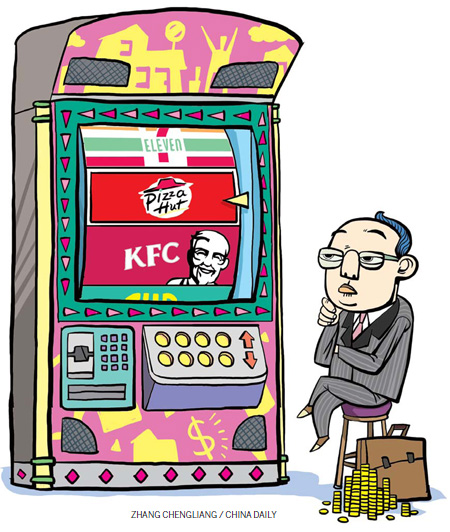
If you are a newcomer to China but want to expand your business quickly in the world's fastest-growing market, you might think about investing in a franchise.
The first and foremost advantage of a franchise is that it can save a lot of money.
A survey by Universal Consultancy in 2009 found that the cost to run a franchise store is about one-third of that to operate a self-owned store.
Cost is always an important factor for an investor. And that is becoming more important as operation costs are running higher in China, thanks to a combination of factors, such as the appreciation of the renminbi and rising prices of land and labor.
Apart from saving money, a franchise also helps an investor reach out to unfamiliar, local Chinese markets.
| ||||


Local franchisees usually understand the local market and have good connections. The familiarity definitely helps a foreign business to expand across China.
However, franchises also have their faults and that is particularly true in China, where they are still relatively new.
Many Chinese people are not familiar with how franchises work. They sometimes change the way of operations that were agreed upon with the franchisers. Some franchisees aren't honest with franchisers about profits. And, some franchisees don't safeguard the value of the brand, and only regard the franchise as a cash cow.
That explains why many retail giants, Chinese or foreign, have reduced the number of franchise stores and increased self-owned ones. These companies include hot pot giant Little Sheep and Hong Kong apparel seller Bossini. Both companies have suffered an over-expansion of franchise stores, which resulted in a decline in the product quality and services in smaller cities, forcing them to shut down or take back some of their franchise outlets.
Based on these lessons, here is the best advice for a franchiser: Never expand beyond your means.
The franchise model is a good tool to use when a company wants to increase its presence in a new market. But if the growth goes beyond its ability to manage multiple stores, it becomes a disaster.
If a franchiser is not sure about how many stores it can manage at one time, a benchmark may help. Make the number of franchise stores fewer than that of self-owned stores. But of course, the rule does not always apply.
The author is an analyst specializing in fast-consuming and retail sectors at Universal Consultancy in Shanghai.
| 分享按鈕 |