Economy
Economists, too, possess concerns with tax law drafting
By Wang Xing (China Daily)
Updated: 2011-06-09 10:19
 |
Large Medium Small |
 |
|
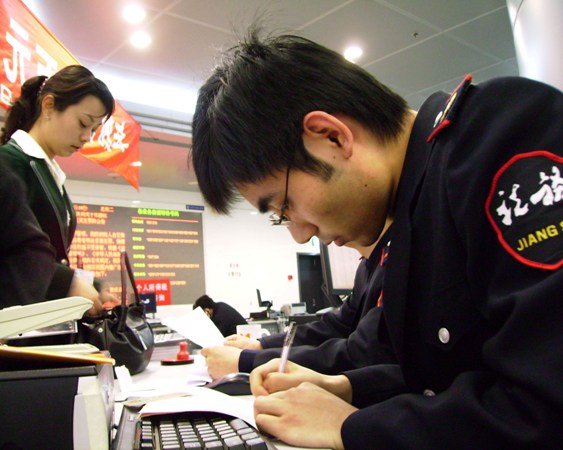
Officers work at a local tax bureau in Suzhou, Jiangsu province. The draft amendment to the Personal Income Tax Law has created a national debate. [Photo/for China Daily] |
BEIJING - After China's latest personal income tax reform plan received a record response from the public last week, Chinese economists also expressed concerns on Wednesday.
While recognizing the government's efforts to reduce the tax burden for low earners, many said the current version of the draft amendment to the Personal Income Tax Law is too conservative to have any significant effect in curbing China's widening income gap.


"Personal income tax has the highest political cost in China. It only generated less than 500 billion yuan for the government last year but bears most of the public's criticism," said Li.
He suggested that the top Chinese authorities should adopt a "single rate" of personal income taxes (as opposed to the current progressive tax rate) to largely reduce the average income tax rate. At the same time, the government should significantly increase its subsidies in social welfare, he added.
In April, the State Council, China's cabinet, posted a draft amendment on its website to solicit public opinion. In it, the proposal was made to raise the personal income tax threshold from 2,000 yuan ($306) to 3,000 yuan.
The draft soon set off a national debate about whether wage earners were paying too much tax and how to curb China's widening income gap through taxation.
On the website of China's National People's Congress, China's top legislator, the draft received nearly 240,000 responses by May 31, the deadline to submit an opinion, breaking the record set by the draft Labor Contract Law in 2006.
The draft is now set for a second review this month and, if approved, could take effect as early as this year.
"I agree with the government's aim of closing the income gap and reduce the burdens on the low-income group, but I think the detailed draft plan has certain flaws," said Liu Zuo, general director of the Taxation Science and Research Institute, an independent research institution under the State Administration of Taxation.
He said the income tax reform should help China to foster a huge middle-income class, which should be those whose monthly income is about 10,000 yuan. "But under the current draft, those who earn over 20,000 yuan per month can also enjoy the tax cut. That would do little to help close the country's income gap," he added.
Under China's old system before the economic reform in 1978, individuals did not have to pay income tax because all salaries were set by the government, which in turn covered most living costs, including housing, education and healthcare.
In 1980, China launched its first income tax system, mostly targeting foreigners working in China. Since then, China has raised the threshold of personal income tax to 1,600 yuan a month from 800 yuan in 2006 and then to 2,000 yuan in 2008.
| 分享按鈕 |