Economy
We fill each other's trade needs: Brazilian envoy
By Ding Qingfen and Tuo Yannan (China Daily)
Updated: 2011-06-07 09:54
 |
Large Medium Small |
|
 |
|
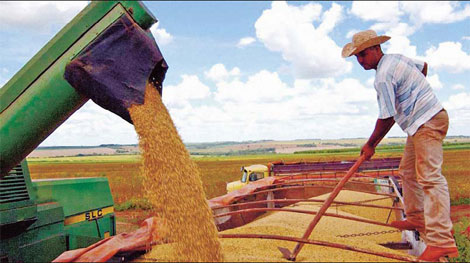
Soybeans being loaded onto a truck at a farm in Brazil. Soybeans, iron ore and oil have traditionally been major Chinese imports from the Latin American country. [Photo/Agencies] |
However, ambassador urges Chinato diversify the range of its imports
BEIJING - China should "diversify" the categories of its imports and its investment in the Latin American nation of Brazil to bring more win-win benefits, the Brazilian ambassador to China told China Daily.
As the two economies are complementary, China-Brazil trade will continue to grow by double digits in 2011 - though not as fast as last year - to probably "$70 billion", he predicted.
Trade between the two emerging economies has been rapidly picking up during the past decade. From 2001 to 2010, China-Brazil trade surged 16-fold and in 2009, China surpassed the United States as Brazil's largest trading partner.
Last year, China-Brazil trade rose by 53 percent year-on-year to $56 billion.
| ||||


"The figure could reach between $65 and $70 billion this year," he predicted.
But the Brazilian official said "there should be some qualitative change in bilateral trade".
China should "diversify its imports" from Brazil, buying more "high-tech goods" such as aircraft, automotive and mechanical equipment, "high-end manufacturing goods" such as luxury shoes, and "agricultural goods" such as beef and pork, rather than merely the "soybeans, iron ore and oil" that traditionally have been the major Chinese imports from Brazil.
The ambassador's remarks echoed the words of China's Minister of Commerce Chen Deming during an official visit to Brazil in May. "China is willing to promote the diversification of Brazilian exports to China and to add more value to Brazilian exports," Chen said.
An estimated 84 percent of China's imports from Brazil are raw materials and agricultural goods including iron ore and soybeans. The huge Chinese demand for the commodities drove an 18-fold increase in Brazil's exports to China between 2000 and 2009.
China is now the largest destination for Brazilian exports and one of the largest buyers of Brazilian mining resources.
"Generally speaking, China and Brazil are complementary in trade. There is potential for China to import more of other goods from Brazil, but the nation needs to learn to promote itself before it can sell the products out," said Long Guoqiang, senior researcher with the Development Research Center of the State Council.
The soaring China-Brazil trade has spurred Chinese investment in Brazil. In 2009, China's investment was less than $300 million, but the figure rose dramatically to a high of $17 billion in 2010, making China the largest foreign direct investor in Brazil.
The ambassador urged Chinese companies to diversify their investment.
"We hope they will keep investing. And we warmly encourage the Chinese to invest in Brazil, especially in the automotive, green-energy, and high-tech sectors and research and development," Hugueney said.
As Brazil will host the FIFA World Cup in 2014 and the Summer Olympic Games in 2016, there are also huge opportunities for Chinese investors, especially in the "infrastructure" sector, such as building airports and railways, the ambassador said.
While bilateral trade rose to a high point, Brazil's trade conflicts kept apace. It is reported that, of the 144 anti-dumping investigations that Brazil launched last year, 50 were against China.
"More Chinese investment is welcomed in the manufacturing sector to avoid trade conflicts between the two countries," the ambassador said.
| 分享按鈕 |