Economy
Ministries ban chemical from babies' bottles over health risk
By Cheng Yingqi (China Daily)
Updated: 2011-06-01 10:06
 |
Large Medium Small |
|
 |
|
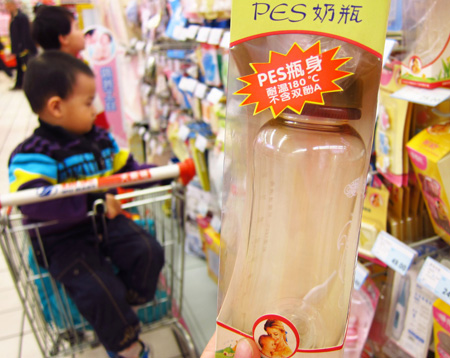
A baby's bottle marked "does not contain Bisphenol A" is on sale at a supermarket in Beijing. The potentially harmful chemical is now being outlawed from all babies' bottles. [Photo / China Daily] |
BEIJING - Six ministries announced on Monday that they have banned the use of Bisphenol A (BPA) in the production of babies' bottles in an attempt to protect the health of infants.
The Ministry of Health and five other ministries issued a joint notice on their websites calling for an end to the production of such bottles starting on June 1. The ministries have also forbidden the import and sale of such bottles starting Sept 1.
| ||||


On April 20, China's health ministry solicited opinions from related government agencies on a draft proposal to prohibit the manufacture and import of infant food containers incorporating the chemical.
When the final regulation was released, the ministry changed the phrase "infant food containers" into "infant nursing bottles" for clarification.
Beijing News quoted an official from the ministry who explained that people sometimes put milk in nursing bottles and then heat them, which makes it more likely that the BPA in the bottles will leech into the milk.
The notice from the ministries also asks local food security inspectors to be vigilant in looking out for violations of the ban.
"Before the EU banned BPA in March, I had no idea about this chemical at all, although I had seen some people discussing the issue on the Internet before who said plastic contained something that was bad for children," said Yang Yang, a 30-year-old Beijing mother who is typical of people who were unaware of the risks until recently.
"I ended up buying glass bottles for my son, even though they were way heavier than plastic bottles and are harder for a baby to hold."
She said she was still worried about the safety of the plastic or rubber teats.
"And I believe the government is responsible for warning us of possible health risks in baby products in advance, instead of following developed countries in banning dangerous chemicals," she said.
BPA is not the only endocrine disruptor babies are exposed to. Around 70 such chemicals have been identified. Although some are already forbidden under the law, others remain in use in the production of plastic containers, toys and pesticides.
Twelve distinct chemicals were listed in the Stockholm Convention on Persistent Organic Pollutants, which is an international environmental treaty that was signed by many countries in 2001 with the aim of eliminating persistent organic pollutants.
"After entering the human body, endocrine disruptors act like the female hormone estrogen and thus probably cause hormone disorders in people," said Pan Xiaochuan, a professor with the School of Public Health at Peking University.
| 分享按鈕 |