Money
RRR rises stifle private sector: Economist
By Gao Changxin (China Daily)
Updated: 2011-05-24 09:43
 |
Large Medium Small |
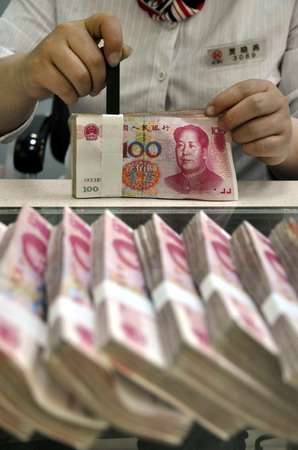 China has raised interest rates twice this year - its benchmark deposit rate now stands at 3.25 percent and its lending rate at 6.31 percent. [Photo / China Daily]? |
SHANGHAI - China should rely more on adjusting the interest rate than reserve requirement ratios (RRR) to fight inflation, because RRR rises disproportionately hurt private-sector businesses, according to a senior economist.
"Increasing the reserve requirement ratio only reduces the amount of lending in society; it does not make the money expensive, as interest rate rises do," said Chen Zhiwu, a Chinese professor at Yale University specializing in macroeconomics, at the 2011 Lujiazui Forum on Thursday.
"And the cheap, but reduced credit resources go mostly to State-owned companies because of their close ties with State-owned banks, leaving private companies struggling for bank loans."
China has tightened its monetary policies significantly since last year to curb inflation after massive bank loans extended since 2009 to heat up the crisis-hit economy pushed up prices, which rose 5.4 percent in March, the fastest clip in 32 months.
After the latest rise on May 13, the fifth this year, RRR levels for the nation's biggest lenders reached a record 21 percent, a level rarely seen among economies worldwide.
Meanwhile, China has raised interest rates twice this year - its benchmark deposit rate now stands at 3.25 percent and the lending rate at 6.31 percent, still low considering the inflation level.
Chen said that many private companies turn to the black market for credit after being turned down by banks. This creates a de facto "double-track" credit market, where underground loan prices are much higher than official ones.
Desperate for loans to maintain their businesses, some private companies have to settle for interest rates of 25 to 100 percent, putting them on the verge of bankruptcy, he said.
In Wenzhou, China's private-capital powerhouse in Zhejiang province, some private companies have been forced to take black market loans with an annualized rate of up to 120 percent, the Shanghai Securities Daily reported.
Many manufacturers in the city are abandoning their businesses to chase higher financial returns by investing in property, stocks and commodities.
"If the official interest rate were higher, the State-owned companies wouldn't have borrowed as much money from banks, leaving a better chance for private companies to get bank loans," Chen said.


"When the inflation rate is higher than the deposit rate, you actually loose money putting your money in the bank," he said.
"And with a shortage of investment channels, China's already fragile middle class is disadvantaged, posing a threat to the country's long-term stability."
Wang Xiaoya, the deputy head of research at the People's Bank of China, said that the central bank looks at the whole economic picture in choosing its monetary tools and that raising the interest rate too high could increase the inflow of "hot money", or speculative capital, which can trigger asset bubbles and economic problems.
Ronald McKinnon, a Stanford University professor specializing in international economics, said the United States' zero-interest-rate policy has contributed to inflation in China, and other emerging economies, by unleashing capital that seeks better returns.
The loose monetary policy in the US also increases commodity prices, a contributor to China's imported inflation.
"The Chinese government is trapped. It is hard for China to take measures, unless they send a delegate to Washington to persuade the US to change its monetary policy," he said.
| 分享按鈕 |