Money
Local banks 'gain rich edge'
By Wang Xiaotian (China Daily)
Updated: 2011-04-21 09:57
 |
Large Medium Small |
|
 |
|
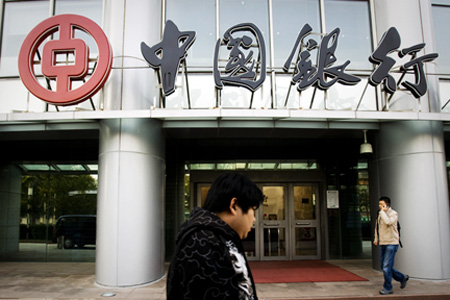
A branch of the Bank of China Ltd in Beijing. According to a study, about 60 percent of high net-worth individuals select domestic banks as the main institution managing their wealth. [Photo / Agencies] |
The number of Chinese high net-worth people nearly doubled since 2008
BEIJING - China's rich prefer domestic banks for wealth management even as their overseas assets expand, according to a report released by China Merchants Bank (CMB) and Bain & Company on Wednesday.
|
||||


"The road ahead for foreign banks on private banking services is indeed bumpy," said Johnson Chng, head of financial services for Bain in Greater China, and the author of the report.
"Foreign banks are losing market share while domestic banks are gaining competitiveness. Moreover, foreign banks are still not yet out from the pressures of global financial crisis," he said.
According to Chng, foreign banks should continue to learn more about the needs of Chinese customers to nurture customer groups.
The number of Chinese HNWIs nearly doubled since 2008, creating bright prospects for wealth management.
The number is expected to rise to about 585,000 by the end of this year and their total investable assets will hit 72 trillion yuan, up 16 percent year on year.
The number of Chinese HNWIs touched 500,000 in 2010 while their investable assets exceeded 62 trillion yuan, up by 19 percent compared with a year earlier.
"Wealth creation in China is marching on unimpeded. This is creating a new, sizeable and discerning class of investors, with unique wealth management needs," said Chng.
Among the respondents, 45 percent prefer private banks and other wealth management institutions as a major investment channel, compared with 15 percent in 2009, suggesting increased trust in private banks. The trend is expected to continue as more than 30 percent of HNWIs indicated that they will further shift their assets to be managed by private banks.
"One important finding is that Chinese HNWIs' overseas assets are expanding gradually with rising demand for investment immigration," said Wang Jing, deputy general manager of CMB's private banking sector.
She said in the past two years the proportion of those people's overseas assets to their total individual assets rose to around 20 percent from less than 10 percent.
"While foreign banks are facing greater challenge, Chinese banks should develop off-shore business positively to meet customer demand for foreign asset management, and connect their domestic strength with off-shore services seamlessly," said Liu Jianjun, retail banking manager of CMB.
The study also finds that the fastest growth is coming from HNWIs with more than 100 million yuan in assets.
The rich mainly reside in Guangdong, Shanghai, Beijing, Zhejiang and Jiangsu, each with more than 30,000 such individuals. But the highest growth rates in the number of wealthy people - 31-40 percent annually between 2008 and 2010 - occur in central and western regions, including Sichuan, Hunan and Hubei provinces, and the Bohai Bay basin, including Tianjin municipality and Liaoning province, according to the report.
In contrast to the survey responses in 2009, the result showed greater diversification of wealth management demand. Wealth creation is the top priority among them, but wealth safety is now the second highest rated objective. In addition, education and inheritance of their children are cited as key wealth management objectives in the latest survey.
"Chinese HNWIs are exhibiting sophisticated investment strategies," Chng said. "They are no longer satisfied with safe, stable investment such as cash, but seek increasingly diversified portfolios."
The largest changes in asset allocation as compared to two years ago are increases in alternative investments, stock and funds, and wealth management products, while cash and deposits, and property saw a major decline.
| 分享按鈕 |