Money
Overseas talent losing pay edge
By Cheng Yingqi (China Daily)
Updated: 2011-02-19 10:01
 |
Large Medium Small |
BEIJING - As the salaries earned by Chinese residents continue to gain ground on the pay granted to workers recruited from elsewhere, mainland employers are becoming more open to hiring overseas talent, a recent survey showed.
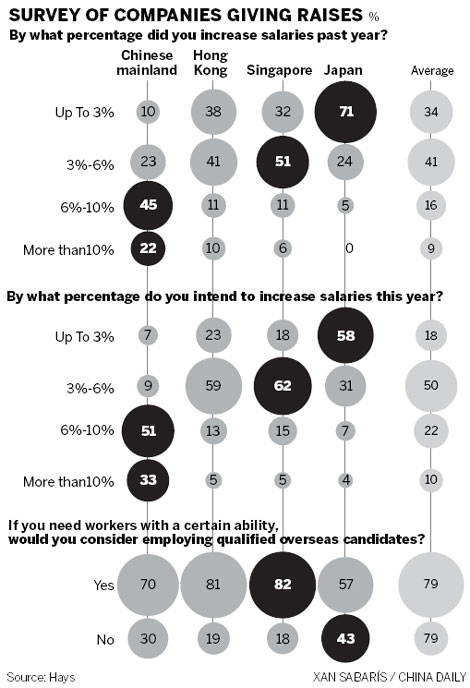
The number of businesses that are willing to recruit job candidates from North America, the United Kingdom, Australia and other places outside the Chinese mainland increased from 50 percent in 2009 to 70 percent in 2010, according to the survey, which was released on Friday by the international recruiting group Hays.
In the past year, the company polled more than 1,000 employers based in the mainland. It found a growing demand for overseas talent, especially for Chinese citizens who have returned home after studying or working in other countries.
Yue Yang, 24, who is studying banking in the United States, said he is thinking about going back to China after he gets a master's degree.
"The banking business in China has more room for career development than in the US," he said. "So I will definitely have better opportunities back there."
In 2009, some 108,000 people returned to the Chinese mainland from abroad, a number that had risen 56.2 percent from the previous year, according to a Guangming Daily citation of statistics recently released by the Ministry of Education.
"For Chinese employers, a 70 percent willingness to hire overseas workers, although that is still lower than the average rate of 76 percent for Asia, is quite a high figure when compared with the past," said Emma Charnock, regional director of Hays in Hong Kong and the mainland, who was in charge of the survey.
In the past, job recruits from abroad, including expatriates and Chinese living in other countries, have earned three to four times as much money as Chinese residents who do not have overseas experience. Expats would often rise to the senior positions within an enterprise, while Chinese who had lived overseas could find positions as mid-level executives with relative ease.
But all overseas job candidates, especially those who lack practical experience, are gradually losing their advantages amid a trend of pay increases in China.
In 2010, the country recorded the greatest rise in wages in Asia. Of all Chinese employees polled about that year, 68 percent said they had received a raise worth 3 percent to 10 percent of their salaries, according to the survey.


"Now it's common in many companies to see recruits from overseas earning the same salaries as their Chinese peers," said Wu Rui, manager of Hays Beijing branch. "Even some experienced expats, on average, earn only 20 percent more than their Chinese coworkers."
Wu said overseas recruits with little work experience no longer enjoy a great advantage over graduates of Chinese universities. But those with two to three years of work experience are still "red-hot".
There are now about 45 million native Chinese living outside the country, the Overseas Chinese Affairs Office of the State Council said on Jun 16, 2010.
| 分享按鈕 |