Economy
Technology can slow production decreases, authorities say
By Jin Zhu (China Daily)
Updated: 2010-12-28 13:34
 |
Large Medium Small |
|
 |
|
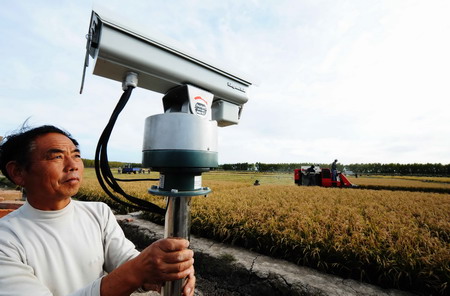
A worker performs maintenance on a camera that is part of the farmland video monitoring system at the 856 Farm in Heilongjiang province in September. The system can collect real-time information about the fields. [Photo / Xinhua] |
The country's annual grain output has surpassed 500 million tons since 2007 and will rise 2.9 percent year-on-year to 546 million tons this year, the seventh consecutive year of domestic grain output's growth.
"China has never had such great harvests before," Minister of Agriculture Han Changfu said.
The minister emphasized that this year's grain production increase, which was more than expected, was highly supportive of the country's overall economic growth.
"The use of technology has determined the country's grain harvest in recent years," he said.
| ||||


In addition, the average harvest of the country's 4,380 high-yield fields is 9.8 tons per hectare, compared with the 5-ton national average.
The central government plans to boost national annual grain output to more than 550 million tons by 2020. That means more advanced agricultural technologies must be adopted.
"More high-yield fields that are resistant to drought and floods will be planted over the next five years," Han said.
Han highlighted concerns that increasing farmland and water shortages, and serious environmental pollution, are expected to pose great challenges to China's agriculture over the next five years.
Analysts said the country still has great potential to increase the input of agricultural technology to advance grain production.
"The technological input still lags compared with input in other fields, such as industry," said Wu Jingxue, director of the Industrial Economy Research Center at the Chinese Academy of Agricultural Sciences.