Economy
China raises interest rate second time this year to curb inflation
(Xinhua)
Updated: 2010-12-27 09:30
 |
Large Medium Small |
|
 |
|
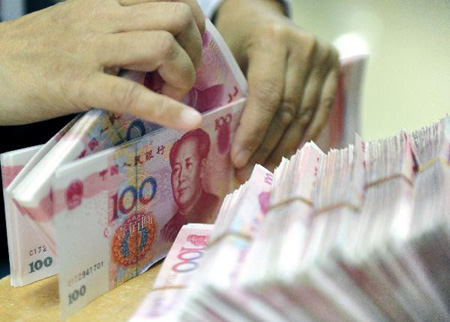
Photo taken on Nov 18, 2010 shows a teller counting the Renminbi at a bank in Qionghai city, South China's Hainan province. China's central bank will raise the one-year lending and deposit interests rate by 25 basis points from Dec 26, 2010, according to a statement posted on the website of the People's Bank of China Saturday.?[Photo/Xinhua] |
China's central bank announced Saturday that it will raise the one-year lending and deposit interest rate for the second time this year, as the government continues its battle against surging prices.
The People's Bank of China (PBOC) said in a statement posted on its website that it will hike the benchmark interest rate by 25 basis points beginning Sunday, which raised the one-year lending rate to 5.81 percent and one-year deposit rate to 2.75 percent.
The PBOC increased the benchmark lending and deposit rates by 25 basis points on Oct 20, which was the first increase in nearly three years.
The rate hike came after the central bank vice governor, Hu Xiaolian, said Friday that China would bring its overall money supply to a normal level using various policy tools, as the government shifts monetary policy from "moderately loose" to "prudent" to rein in rising inflationary pressures and curb asset bubbles.
The country's consumer price index (CPI), a main gauge of inflation, accelerated to a 28-month high in November of 5.1 percent, while new loans reached 7.45 trillion yuan in the first 11 months of this year, compared to the government's full-year target of 7.5 trillion yuan.
A recent PBOC survey also showed that the proportion of Chinese citizens satisfied with the current price level had sunk to an 11-year low, and only 17.3 percent of the consumers said they intended to consume more in the future.
Rising prices have prompted the government to take measures to rein in the hikes, including boosting supplies and providing financial aid to the needy.
Li Daokui, a member of the monetary policy committee with the PBOC, said the rate hike mainly aimed at managing inflationary expectations and reflected the policy shift, as tightening the money supply is the best way to curb inflation.
The rate increase came "at the right time", as western countries are celebrating the Christmas holiday, to avoid overreaction from the global markets, Li added.
Besides interest rate hikes, China had increased the bank reserve requirement ratio six times in 2010 to 18.5 percent and 19 percent for some large commercial banks.
"The decision was made in consideration of China's economic condition next year," said Lian Ping, chief economist with the Bank of Communications, the country's fifth largest lender, who described fighting inflation as the central bank's primary task at present.
Lian expected inflation to continue to go up in the first quarter next year due to rises both in demand and cost, as well as other influences from the external market.
His views were echoed by Zhuang Jian, chief economist with the Asian Development Bank, who also attributed rising inflation to holiday seasons and the extreme winter weather.
| ||||


"You cannot expect one or two rate rises to have a significant impact on economic indicators," said Zuo Xiaolei, chief economist with Galaxy Securities.
However, Lian said China only has room for two or three rate hikes, as higher interest rates would increase risks of "hot money" inflows due to a widening interest margin between China and the United States, which is likely to keep rates low.
Li Daokui also attributed the timing of the rate increase to avoiding rapid capital inflows.
But currently the factors that decides the direction of capital flows are currency exchange rates and assets prices, Lian added.
UBS Securities economist Wang Tao said last month that she expected the central bank to raise the interest rate by 25 basis points before the end of the year and by another 75 basis points in 2011.
China's economy grew 9.6 percent year-on-year in the third quarter this year, slowing from the 10.3 percent increase in the second quarter and 11.9 percent in the first quarter.
The country targets about a 3 percent inflation rate in 2010.