Opinion
Challenges of charging ahead in electric cars
(China Daily)
Updated: 2010-12-13 13:15
 |
Large Medium Small |
|
 |
|
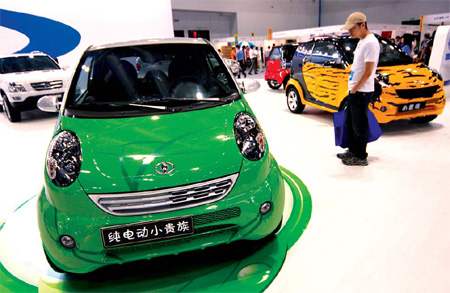
The Shuanghuan brand electric car is made in Shijiazhuang, capital of Hebei province. [Photo / China Daily] |

Media reports last summer from China said the government plans to invest 100 billion yuan ($15 billion) to support the development of electric vehicles and advanced battery technology in the country.
The reports said the government's goal is to have 5 million electric vehicles (EVs) as well as another 15 million hybrid-electric vehicles on the roads by 2020.
The rationale behind this initiative is clear.
Today, China consumes about 8 million barrels of oil a day - or nearly 10 percent of the 88 million barrels consumed globally on a daily basis - the majority of it imported.
During the coming decade, China is expected to add nearly 200 million passenger vehicles to its fleet, pushing the number in operation to more than 250 million.
Already the world's largest emitter of carbon dioxide, the additional pressure from those vehicles on China's environment, public health and oil supplies is forcing leaders to look for alternative energy solutions.
A seemingly obvious solution is a migration to hybrid and electric vehicles, which require little or no oil and produce little to no tailpipe emissions.
But can China successfully transition to a hybrid and electric vehicle industry? Based on JD Power's experience working in markets around the world, success is not guaranteed.
There are a myriad of challenges that need to be overcome for EVs to become commonplace in China.
The most important are technical obstacles to making EVs cost competitive and overcoming consumer skepticism.
EV technology has been around for more than a century and at one point was more common than petroleum power.
It wasn't until some simple innovations empowered the internal combustion engine - among them the electric starter and widespread availability of gasoline - that it overtook the battery as the preferred power source for the world's vehicles.
Yet many of the challenges faced by modern EV technology are the same as they were more than a century ago:
Limited driving range: Electric battery packs do not now hold the desired volumes of energy, which limits driving range.
As a result, many consumers have "range anxiety", a concern that their vehicle will not get them to their destination or they cannot drive their vehicle over long distances.
Limited support infrastructure: Currently, there is inadequate infrastructure available to support EVs, which means the owner of an EV cannot confidently drive long distances and be assured of a recharge far from home.
An adequate national infrastructure might help alleviate range anxiety, but it would also cost billions of yuan to build and would need to provide a way for overnight charging by residents of apartments.
Charging times: Completely recharging batteries in an EV can be inconveniently long - ranging from 3 to 12 hours depending on the system used.
| ||||


Despite the challenges, JD Power's global research finds that many consumers are interested in hybrid and electric vehicles because of their ability to reduce dependence on oil and lower exhaust emissions - yet interest dissipates substantially when they learn the price premium such vehicles carry.
Today, most hybrid and electric vehicles cost 25 to 100 percent more than a comparably sized conventional vehicle.
Given the skepticism about EV technology, few consumers are willing to pay a premium for a product that potentially offers more inconvenience and potential problems.
All things considered, China is doing the right thing in exploring alternative energy solutions to support its national automotive industry. Due to the size of the vehicle population and the rate at which it is increasing - as well as general concern for the environment - it is the right move.
But much work needs to be done on technological advances, infrastructure development and education to gain consumer acceptance in China, and elsewhere, in the near future.
While the going will not be easy, China has a unique opportunity to take the global lead in the greening of the auto industry. The nation's ability to quickly coordinate and implement automotive policy may be just what's needed to jumpstart the electric-vehicle future.
The author is senior-vice president of International Operations for JD Power and Associates.