InfoGraphic
Food to stay costly
(China Daily)
Updated: 2010-11-22 10:53
 |
Large Medium Small |
|
 |
|
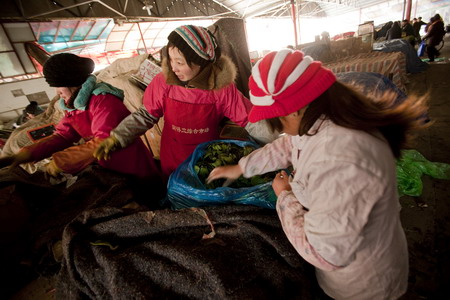
Vendors sell vegetables in Beijing. Vegetable prices have risen sharply in major cities across China since the start of this year. [Photo / Bloomberg] |
BEIJING - The price of food including soybeans, corn, wheat, cotton, mung beans, ginger, garlic, ginseng, honeysuckle, cabbages, sugar, apples and soybean oil rose far beyond its real value last month, said analysts.
According to Chen Shuzhen, a retailer at Xinfadi market, the largest trading hub for vegetables, fruit, meat and seeds in Beijing, the next necessity costing more is starchy flour, a kind of potato carbohydrate, which has gone up from 6 to 7 yuan (about $1) per kilogram to 20 yuan per kg. Consumption is expected to stay high because every family uses it to thicken dishes.
Some analysts said seafood, especially sea cucumber from the Bohai Sea, will also see price inflation, because the Chinese like to consume more nutrients as winter sets in. Others argue that products with the longest shelf life will undergo speculation, causing them to rise in price.
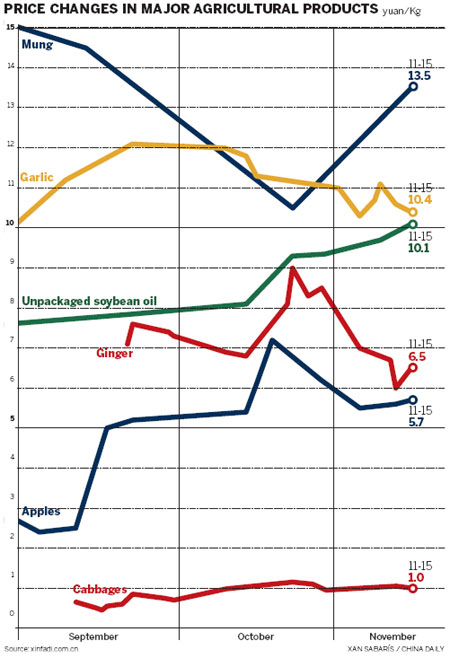
The price of cabbage, the most-consumed vegetable in North China, has tripled month-on-month to 1.5 yuan per kg in big cites including Beijing and Shanghai following a reduction in production and a popular rumor that huge amounts will be exported to South Korea, where there is a shortage of pickles. The price undermines the traditional Chinese saying "As cheap as a cabbage".
Since November, the price of sugar has soared to more than 7,000 yuan a ton in Nanning, Southwest China's Guangxi Zhuang autonomous region, the country's main sugar producing area. It has risen almost 20 percent a ton over the past half month.
Soybean, wheat and rice have become so expensive on the Chinese mainland that many Shenzhen residents are traveling to Hong Kong to buy food, China's Nanfang Daily (Guangzhou) reported recently. Soy sauce, soybean oil, amylum (starchy flour) and other products made from cereals now have an average price that is 20 percent higher than in Hong Kong after taking the exchange rate into account.
"The soaring price of soybeans, on imports of which China heavily relies, is driven by the global commodity market first rather than the Chinese spot market, the same as what happened with garlic, ginger and apples," said Li Pan, an agriculture analyst from GF Futures Co Ltd. "With the US latest easing policy on liquidity, the price will stay high."
Cotton, of which 30 percent is imported from other countries, vegetables and fruit, are speculated over more by local investors, Li said, adding that since the government became more watchful over the real estate and stock markets this year, as well as keeping the interest rate of savings deposits low, more idle money floated to the commodity sectors, including agricultural produce.
| ||||


She added that a recent report indicated the present situation is displaying more of the characteristics of finance than of economic fundamentals. In a country where food makes up more than 30 percent of the consumer price index, it puts big pressures on Chinese citizens.
Qin Jun, an analyst from Guotai Junan Securities, said it's hard to tell which agricultural product rises in price for which single reason. Cold weather and heavy rain this year led to shortages in some areas.
In Xinjiang Uygur autonomous region, where China's good quality cotton grows, local farmers saw more individual cotton buyers than ever from Wenzhou, where businessmen are famous for their taste for speculation.
The migrant buyers were named "little white hat" by local people because they wrapped their hair in white cloth to stop strands from falling into the cotton, according to a Beijing Television program.
Major grains are collected by China Grain Reserves Corporation and other State-owned food companies. Food that is not consumed on a daily basis, such as mung bean, garlic and ginger, are hoarded temporarily to limit availability and subjected to speculation.
Data from the Ministry of Commerce showed the wholesale price of garlic in the 36 cities across China rose 95.8 percent on average while ginger rose 89.5 percent during the first 10 days of November.
Speculation over non-staple products differed, the Economic Observer (Beijing) reported. Ginger, which can be stored for three years, was held on to by farmers. Garlic which has to be frozen if it is to be kept, was highly profitable for middlemen rather than farmers and retailers. Honeysuckle, as an important ingredient of Cantonese herbal tea, was hoarded by big players in the beverage industry such as Guangzhou-based Wanglaoji with the expectation that the raw material's price will surge.