Economy
Rich 2nd generation waiting in the wings
By Zhao Yanrong (China Daily)
Updated: 2010-11-19 16:35
 |
Large Medium Small |
WENZHOU, Zhejiang - Yu Yizhou is a good-looking man who could pass off as a film star.
Indeed, he wanted to get into movies, by studying film production in Britain, but his parents refused to pay his tuition fees, and would only agree to him enrolling in a business school.
The reason: Yu, now 27, has been earmarked by his father to inherit a multimillion-yuan shoe factory in the city of Wenzhou, in East China's Zhejiang province, and wanted to ensure the son will have the right training to run the business.
Yu is just one of many young people in China poised to inherit family businesses, a large proportion of the country's 7 million private firms.
Thirty years after China's economic reform, private enterprises have become the backbone of the country, with family enterprises playing a major part. Now, with the founders planning retirement, most of them are hoping the business will be passed down to a family member.
However, it has been a struggle for some who will be taking over the business.
A Guangdong Federation of Industry and Commerce report in September said more than 60 percent of family enterprises plan to hand the business to their children, and half will do so within 10 years.
In South China's Guangdong, which has the biggest economy among China's provinces, more than 40 percent of the economy was contributed by family enterprises.
Throughout China, there are more than 7 million private enterprises, which contributed 70 percent of the country's total GDP, Xinhua News Agency reported.
They control 20 trillion yuan ($3 trillion) in capital and pay about one-third of taxes. Private enterprises create more than 80 percent of new jobs.
As such, the strength and continuation of family businesses affect not only the future of private enterprises, but also the country.
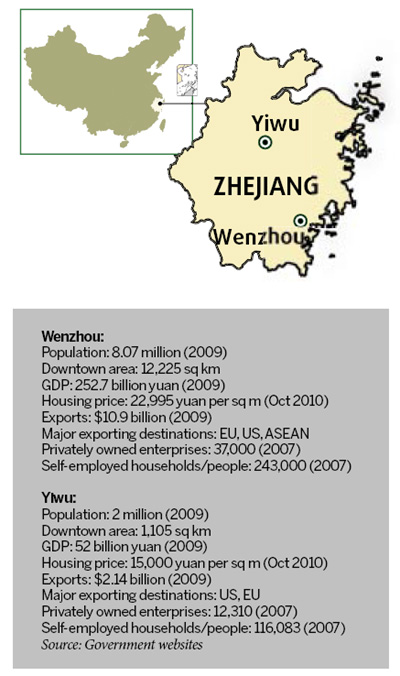
Wenzhou, one of the first cities in China to set up individual and private enterprises after the economic reforms of the late 1970s, has more than its fair share of family enterprises.
It is also home to large shoe-manufacturing operations, including the Yu family company, Sincere Shoes.
Yu, who will inherit the company from his father, said being born into wealth means "more responsibilities".
"I might follow my interests in film for fun, but I think I will never have the chance to make it as my career," he said.
Nevertheless, he sometimes envies his younger sister, a marketing assistant for a cosmetic company in Shanghai. "She is doing what she wants, which is less stressful and more passionate," Yu said.
Many of the young people are having a hard time dealing with their parents, who are willing to pass on the business to them, but still retain control.
"Conflicts between the young and their parents are very common," said Chen Xuepin, co-founder of Relay China Youth Elite Association, an association for young leaders from family companies. The association has recruited more than 100 members over the past three years since it began in 2007.
Chen said up to 30 percent of its members studied abroad. "Different education background and experience of growth make the two generations have very different understandings," Chen said.
Most family enterprises were started by people with only basic education, relying on hard work, social networks and opportunities to succeed.
However, their children are generally better educated, with many having studied advanced and modern management theories.
But with many founders still in charge, young leaders are finding it difficult to get their ideas implemented.
One example is Xie Shusheng, who controls a third of another multimillion-yuan shoe company in Wenzhou, Dibang Shoes, which is still run by his father.
Xie has started putting his management ideas in the warehouse of the company, installing several computers.
Before this, the warehouse team would record all movements in a notebook and due to inaccuracies, many products would go missing.
But while the computerized system is working well and improving daily, Xie's father would remember only the mistakes he made. "I've been working with my father for a year, but I have never heard any approval from him yet."
Xie, who was born in the 1980s, said his father used to sleep for only four hours a day when he started the business with fewer than 10 employees. Today, despite the company employing more than 1,000 workers, the founder still wants to deal with everything himself.
"He would even call the cleaners directly if he saw a piece of paper lying in the compound," Xie said.
Xie also has difficulties with some mid- to high-level executives, especially some senior managers who have been with the company for more than 20 years. "They may not want me as a young boss, who they have been seeing as a child all the time," he said.
Xie's career path with the family's company was set by his parents.
"When I was sent to study in Canada after high school, I was told to take business programs," said Xie.
"As I am an only child, I knew I would be asked to come back and take over the family business."
 US companies still want to do business


The city of about 8 million also exudes wealth, with many young people driving expensive cars.
Chen from Rely China said those second-generation managers are like star staff members, who are being closely watched. If they do well, some will say that is how it should be. But if they fail, they'll be blamed for not doing enough.
Many local governments, such as those in Zhejiang and Guangdong provinces, offer training courses for the young, particularly those not familiar with company management, covering such topics as the Chinese business environment and efficient ways to run a company.
However, some experts suggest that family enterprises should consider employing professional managers, rather than forcing their children to take over.
Qian Xuefeng, from the Zhongnan University of Economics and Law in Wuhan, Hubei province in Central China, said that improving the management system may be more useful than improving the quality of the young generation.
The future of family enterprises lies in a modern system, where ownership and management are separated. Reform can only be carried out by professional managers, Qian said.
Chen supports the concept of professional managers, but he said it is still early for family companies to do so as there are not enough professional managers in China to support private enterprises, and owners trust their family members more than other people.
"It's same as survival of the fittest. Only the young can withstand the pressure from inside and outside the company."