Economy
Trade deficit with Southeast Asia balloons
By Lan Lan (China Daily)
Updated: 2010-08-26 11:55
 |
Large Medium Small |
Chinese firms can use agreement as springboard to markets abroad
BEIJING - China's trade deficit with Southeast Asian nations ballooned to a record since the bilateral free trade agreement was put into force this year, sparking concerns that the agreement has become a catalyst for the trade deficit.
 |
|
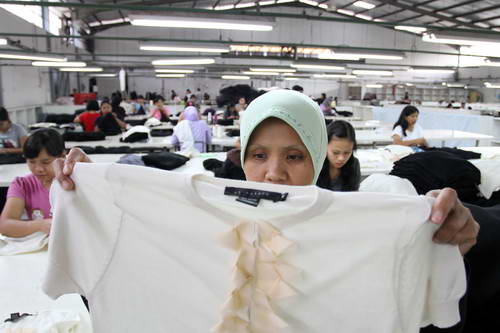
A worker inspects a shirt at a garment factory in Bandung, West Java, Indonesia. China’s trade deficit with the Association of Southeast Asian Nations soared in the first seven months after the free trade agreement between the regions took effect on Jan 1, 2010.?[Photo/Agencies] |
Beijing doesn't seek a trade surplus with the Association of Southeast Asian Nations (ASEAN), Sun Yuanjiang, deputy director general of the Department of International Trade and Economic Affairs at the Ministry of Commerce, said at a press conference on Wednesday.
China's trade?deficit with Southeast Asian nations soared to $7.5 billion in the first seven months, compared to $400 million in the same period last year, thanks to the free trade agreement that into effect on Jan 1 this year.
Since the purpose of inking the agreement was to ensure that Chinese companies benefit, domestic companies are urged to move swiftly to take full advantage of the agreement, Sun said.
"Chinese companies investing in ASEAN countries can use this region as a springboard to enter overseas markets," said Xu Ningning, executive secretary-general of the China ASEAN Business Council.
The opportunity will allow Chinese companies to build a new industry value chain and bolster Chinese product competitiveness in international markets, Xu said.
China's non-financial investment in ASEAN was about $1.2 billion and ASEAN's investment in China was $3.1 billion in the first half of the year, according to the Ministry of Commerce.
The majority of domestic companies are aware of tariff cuts on goods from ASEAN countries but have little knowledge about the advantages of the investment agreement.
The investment agreement between the two sides, which also took effect on Jan 1, committed to supplying a fair investment mechanism for investors from both sides. Chinese companies investing in ASEAN countries can also enjoy most-favored nation treatment.
Some ASEAN countries have signed regional free trade agreements with countries such as Japan, South Korea and Australia, which can also help Chinese companies enter these markets, Xu added.
| ||||


To boost cooperation, the first China-ASEAN Industry Cooperation Conference is due to be held in September in Kunming.
Bilateral trade between China and ASEAN members rose to $161 billion in the first seven months, up 50 percent year on year.
The growth rate is also 9 percentage points higher than the nation's overall imports and exports.