Economy
Getting a handle on flow of hot money
By Cao Li and Yu Ran in Wenzhou and Jiang Xueqing in Beijing (China Daily)
Updated: 2010-08-11 09:03
 |
Large Medium Small |
|
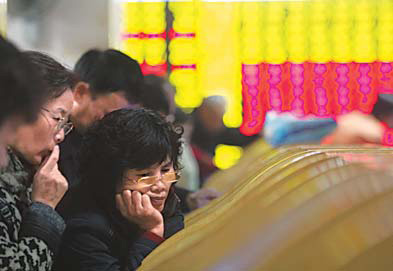
Residents of Wenzhou, Zhejiang province, check stocks at a brokerage in the city in this file photo. Zheng Peng / for China Daily |
Last year, the city recorded a GDP of more than 252 billion yuan, the third highest in the province behind Hangzhou, the capital, and Ningbo.
Although Zhang Zhenyu, director of the city government's financial office, says the city has around 400 billion yuan of private capital (excluding bank deposits), others put the figure in the region of 800 billion yuan.
Of the more than 80 recognized business sectors, 62 are open to foreign investment and 41 allow domestic private capital, said Zhou at the enterprise development association.
Improving the safety of how that money is invested and ensuring it reaches the right projects is an important job for the Wenzhou authorities, added Zhang.
After enjoying boom times in the 1990s, Wenzhou went through an economic transformation in 2002 when the government began closing small, inefficient workshops to rein in pollution. Since then, residents have pumped their money into coal mines, cotton plantations and oil fields.
According to local lawyer Wu Zuchun, by July last year villagers in the city's Pingyang county alone owned more than 200 coal mines in Shanxi province, amounting to a total investment of 30 billion yuan. Investment has also been made in the Inner Mongolia autonomous region, as well as Gansu and Guizhou provinces, all of which are rich in nonferrous metal reserves.
Chen Jiyan, who spent 15 million yuan on a coal mine in the Xinjiang Uygur autonomous region's Aksu prefecture in 2004, said his assets have since risen to more than 400 million yuan.
Properties in popular cities like Hangzhou and Shanghai has also been a major channel for speculation.
"Every household in Wenzhou owns an average of 1.2 properties in Shanghai," said Gao Lei, who runs a Wenzhou Computer Market Development, a company with about 100 staff. He owns 30 properties nationwide, including five in Shanghai. "It is a way to manage my wealth," he said.
Although investors like Gao have been blamed for creating the housing bubbles the Chinese government are now trying to deflate, Ma Jinlong, director of the Wenzhou Economics Study Association, argued that businessmen and women naturally go where the profits are.
"Their speculative investments in short-term, big-return projects have been dictated by China's economic structure," he said.
Yu Hui, a researcher with the Institute of Industrial Economics of the Chinese Academy of Social Sciences, said he feels the trend has been fueled by the investors' lack of confidence in long-term development projects, due largely to the sometimes-inconsistent government policies on private investment.
"Most sectors don't ban private investment," he said, "but in practice there is a glass ceiling. In some cases, private investors find it difficult to enjoy equal support."
In an interview with Xinkuaibao, a newspaper based in Guangzhou, Guangdong province, Wang Yusuo, chairman of ENN Group, complained that his clean energy project had failed to obtain government funding and support because his company is not State-owned.
However, 41-year-old Wenzhou entrepreneur Zeng Changbiao said he believes businesses that reflect the government's vision for sustainable growth will win out, even though the returns may be slower in coming.
He has pumped about 8 billion yuan into a real estate project in Huludao, a city in Northeast China's Liaoning province, which, he says, "is in accordance with the government's decision to propel the area's economy".
Speculative investments made without any awareness of policy and macro economic changes will not make a penny in the end, added Zeng, who is also chairman of the Zhejiang Chamber of Commerce in Liaoning, which has more than 200,000 members.
Funneling funds
To prevent more coal mine accidents, the Shanxi government last year reshuffled the industry, demanding that small and medium-sized companies be merged.
"Wenzhou private investors lost more than 20 billion from Shanxi mining industry," said enterprise development association chief Zhou.
The central government has also unleashed policies this year to cool down the overheated property market, meaning even more private capital is now burning holes in investors' pockets. "Capital just sat there waiting for the right investment opportunity," said Zhang in the city's financial office.