World Business
Putin tax breaks to shrink debt
By Paul Abelsky and Denis Maternovsky (China Daily)
Updated: 2010-07-08 10:12
 |
Large Medium Small |
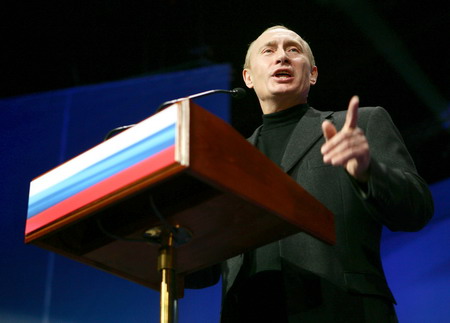
Russian Prime Minister Vladimir Putin speaks at a political rally in Moscow.[Agencies]
PM aims to cut Russian firms' international loans
MOSCOW - Prime Minister Vladimir Putin is seeking to cut the amount of international loans owed by Russian companies more than 50 percent with tax breaks that would increase the allure of bank credit denominated in roubles.
The government aims to reduce foreign-currency debt to 20 percent of total corporate borrowing from 42 percent by doubling the amount of rouble interest payments eligible for tax deductions, said State Duma Deputy Natalia Burykina of Putin's United Russia party, who helped draft the plan. Companies have $294 billion of international and 12.8 trillion roubles ($410.8 billion) of local loans, data compiled by the central bank show.
Overseas borrowing exacerbated Russia's worst economic crisis since the Soviet Union's fall as a weaker exchange rate increased the cost of repaying dollar loans last year and forced more than 100 Russian corporate executives to seek government aid.
Tax incentives will reduce the cost advantage for companies to borrow abroad, said Giacomo Baizini, chief financial officer at Evraz Group SA, Russia's second-largest steelmaker.
"More companies will be induced to issue debt in roubles," Moscow-based Baizini said in an e-mailed response to questions. The current tax incentive is too low to spur rouble borrowing because local interest rates are comparatively high, he said.
The annual cost for companies to borrow in roubles is the lowest since July 2008 at an average 11.4 percent, compared with 8.5 percent on dollar loans, according to data from the central bank in April. Non-deliverable forwards show the rouble 4.14 percent weaker in a year. Including the cost to hedge exchange-rate risk through so-called NDFs, rouble borrowing is 1.2 percentage points cheaper than loans in dollars, according to data compiled by Bloomberg.


The proposed law, which went before the lower house of parliament on Wednesday, would increase the tax-deductible portion of interest payments on rouble borrowing to 1.8 times the central bank's benchmark refinancing rate, currently 13.95 percent, from 1.1 times, Burykina said. The taxable portion of foreign-currency loans will be set at 0.8 times the refinancing rate, or 6.2 percent, from a flat rate of 15 percent now, she said.
Russian companies more than tripled foreign debt in the three years before the global financial crisis in 2008 as borrowing costs fell to a record low. Rising repayment costs after the rouble's 35 percent tumble against the dollar between August 2008 and January 2009 forced the government to provide $11 billion in rescue funds.
Russia's biggest property developers, including Moscow-based PIK Group and Sistema Hals, were forced to cede assets after failing to meet debt commitments.
International Industrial Bank, the lender controlled by lawmaker Sergei Pugachyov, said it defaulted on 200 million euros ($252 million) of bonds that matured on Tuesday.
"The government is paranoid about repeating the mistakes that led to the crisis of late 2008 when dozens of major corporations had to be bailed out with state funds because they had over-leveraged with foreign currency debt," said Chris Weafer, chief strategist at UralSib Financial Corp, the Moscow-based lender owned by billionaire Nikolai Tsvetkov.
Bloomberg News