Companies
Giving collectivization a go
By Wang Wen (China Daily)
Updated: 2010-07-01 13:27
 |
Large Medium Small |
Since 2007, the wage standard on Guijie, a street in Dongcheng district famous for its many restaurants, has been fixed. More than 90 restaurants on the street signed wage contracts to adopt the minimum salary in the area.
 |
The minimum wage standard in Beijing will be raised to 960 yuan per month, which means it will increase to 1010 yuan per month on Guijie after July 1.
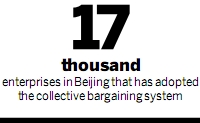
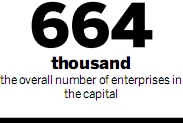
While a collective bargaining system has been in place in Beijing since 1996, it has lacked widespread implementation. Over the past 14 years, only 17,000 enterprises successfully adopted the system.
"The number is not satisfying," Huang said. "One of the main difficulties is from employers who still think they have the ultimate decision-making power over workers' wages and that it will add human resource costs to raise wages."
|
 |
Although collective bargaining was established in China in 1995 when labor laws were put into effect, Huang said there are no strict rules forcing companies to adopt such a system and many companies do their best to delay or avoid implementing one at all.
"If employers do not want to accept the collective bargaining system, we do not have any solutions," Huang said. "Employers attitude towards the system largely determines the whole process."
Some companies say they do not object to collective bargaining.
"Collective bargaining can bring long-term benefits to companies," Susan Hu, a human resource manager with a foreign public relations firm in Beijing, said.


"To accept collective bargaining is also a challenge to trade unions," Huang said. "Trade unions need to improve our capabilities to protect employees' rights."
Liu Yuanwen, deputy dean of the trade union department with China Institute of Industrial Relations, said the concept of trade union is not one that is well understood yet in the country.
"There is a lagging perception that it is about negotiations rather than bargaining in the domestic context," Liu said.