Opinion
Taiwan must march westward to prosper
By Liu Hsiao Hsu (China Daily)
Updated: 2010-05-12 13:53
 |
Large Medium Small |
In late April, the leaders of the two biggest parties in Taiwan, Kuomintang (KMT) and Democratic Progressive Party (DPP), engaged in a crucial open debate on the proposed Economic Cooperation Framework Agreement (ECFA) between the Chinese mainland and Taiwan. The debate drew the attention of compatriots on both sides of the Taiwan Straits.
The ECFA can be seen as a transitional agreement on way to a free trade zone across the Straits. If it is signed, the mainland and Taiwan would in 10 years reduce the Customs duty to zero on more than 90 percent of agricultural and industrial products. According to the agreement, Taiwan could continue to sign free trade agreements with foreign countries and thus keep expanding its exports and avoid being discriminated against in trade.
| ||||


Opening the debate, Ma Ying-jeou, chairman of KMT, declared: "Trade is the lifeline of Taiwan. Without trade, there would be no Taiwan." He said: "We cannot put all our eggs in one basket, but how can we not put any egg in the biggest basket."
Ma's words reflect the nature of the island's economy and the thoughts of most of the Taiwan people. Taiwan's economic power has dwindled and unemployment rate risen in recent years. Only if it strengthens its export competitiveness and expands its foreign trade can investment be stimulated in order to boost employment and consumption and restart rapid economic growth. It is the only way to address the root cause of Taiwan's economic plight.
Tsai Ing-wen, chairperson of DPP, was of course firmly against the ECFA. The DPP, however, cannot deny two vital facts about Taiwan's economy. First, the island cannot change the current trend of globalization and regional economic integration, and its economy cannot survive isolation from the outside world because it is highly dependent on the international market. Second, Tsai's opposition can neither change the mainland's status as the world's workshop and gigantic market, nor cut its geographic and cultural ties with Taiwan.
That Taiwan can do without sharing the benefits of the mainland's economic rise is only the wishful thinking of Tsai and her party. Their narrow-mindedness can only isolate Taiwan from the development of the world. The DPP can only oppose the ECFA. But it has no specific plan to revive Taiwan's economy, showing that it is incapable of bridging the gap between reality and its ideology.
The American Chamber of Commerce in Taipei (AmCham) has supported the signing of the ECFA, showing Taiwan has to go through the agreement to take its economic development forward. The AmCham believes Taiwan would be more successful in luring foreign investment if the ECFA, which reduces tariff on exports from Taiwan to the mainland, is signed.
Taiwan's advantages, such as research and development, robust protection of intellectual property rights, and a sound legal system, could be amplified by the agreement, making Taiwan a bridgehead to the mainland market and a strategic point in the East Asian economy. Otherwise, the competitiveness of Taiwan's products in the mainland market would be impaired, and Taiwan's economy could be marginalized.
In this age of globalization, even if Taiwan fends off competition from the mainland, it cannot escape that from foreign countries. Through free trade agreements the distribution of economic resources could be ameliorated, every economy could specialize in producing goods they have advantage in, and competition could be intensified. If Taiwan officials ask the mainland only for unilateral concession, they will not win the respect for Taiwan. Plus, excessive protection for some industries in Taiwan is not a good thing.
A responsible government should bravely tell the people its plan in detail so that they know the gains and losses involved and can prepare for the consequences. If this is done, the firms that intend to enter the mainland market will know when tariff would be reduced and can choose the best time to invest. The enterprises that want to stay in Taiwan can plan to upgrade their industries based on when it would open up for free trade.
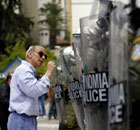
With the topic of ECFA heating up in Taiwan, DPP has started resorting to populist maneuvers, such as protests and parades, which it is good at. It may even call for referendum on ECFA. More worrying is the fact that it will make use of the opportunity to hijack the topic in the campaign for elections in the five municipalities of Taiwan.
The DPP's tricks, however, should not prevent Taiwan from making the right decision. Michael Porter, a professor at the Business School of Harvard University, said recently that, when economies of varied sizes form a free trade zone, the smaller ones usually gain more because they get access to the larger markets. Taiwan should not waste more time in pointless infighting, and instead welcome the ECFA. If Taiwan's economy marches bravely westward it will definitely prosper again.
The author is a Taiwan businesswoman and research fellow in the Renmin University of China's Law School.