Top Biz News
Activists seek ban on Beijing's brisk ivory trade
By Shen Jingting (China Daily)
Updated: 2010-02-09 13:02
 |
Large Medium Small |
|
 |
|
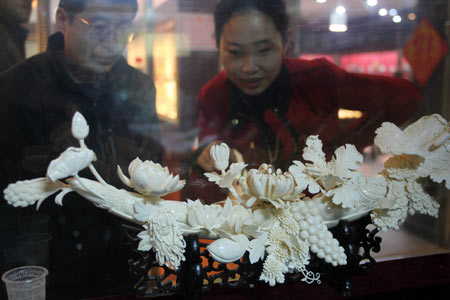
Customers?select ivory products at an antique shop in Beijing. [China Daily] |
Animal protection activists are calling for a complete ban on ivory trade as many Beijingers snap up ivory products to give as gifts for the Spring Festival.
In Beijing Antique City, Asia's largest trade center for artworks and antiques, ivory stores are short of stock. Some vendors said they could easily earn up to 500,000 yuan in the month ahead of the Chinese New Year.
"Many people buy ivory products as Spring Festival gifts," said Gu Yunfeng, owner of an ivory store in Panjiayuan's Tianya antique city.
Gu said business was good and he was waiting for new products to fill his empty shelves.
"In Chinese culture, an elephant is an auspicious omen because the character 'xiang' sounds similar to the character 'xiang' in 'jixiang', meaning 'lucky fortune'," said Wang Shan, secretary general of the China Arts and Crafts Association, and the person in charge of the affiliated China Ivory Carving Association.
He said Beijing is one of the largest ivory markets in China and the city owns eight out of the 33 registered processing factories approved by the State Forestry Administration.
China imported 61 tons of ivory from four African countries in 2008, and Beijing-based manufactures grabbed over half the tusks. The ivory was intended to cover the market for nine years, said Wang, whose organization took part in negotiations at CITES, the Convention on International Trade in Endangered Species, with several Chinese ministries in the year.
In that year, China and Japan were permitted to import ivory from Botswana, Namibia, South Africa and Zimbabwe.
"We hope the world can try to understand why China consumes ivory. 7,000 years ago, Chinese ancestors along the Yangtze River made beautiful ivory cups and combs. The art flourished in Ming and Qing dynasties," he said.
Wang added that Chinese ivory carving businesses suffered badly after the international community banned the trade of ivory in the late 1980s. Its number of employees shrank from 7,000 at the time to just 200 in 2008.
| ||||


"Saving a lost art should not be at the cost of killing endangered animals," he said.
He said IFAW is calling for a complete ban on ivory because the demand is having an effect on illegal poaching.
The number of elephants in Africa has shrunk to 470,000 from one million only 20 years ago.
In Beijing's subway stations along Line 4 and Line 10, IFAW has put up posters to persuade people to stop buying ivory goods.
Wang said although China needs more ivory, he would not support parties who suggest greater trade at this year's meeting in March.?