BIZCHINA> Top Biz News

|
BIZCHINA> Top Biz News
|
|
Chinese upper class growing
By Tan Yingzi (China Daily)
Updated: 2009-06-18 07:47
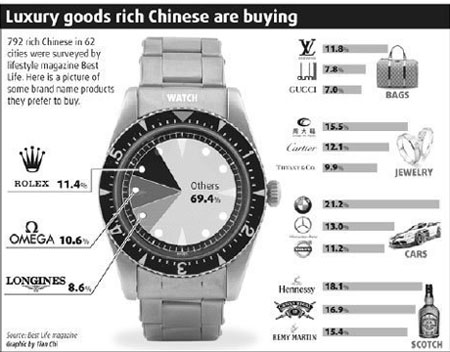
More than half of nearly 800 wealthy Chinese recently polled believe the widening gap between the rich and poor is also creating an emerging upper class in the country. The survey, carried out by lifestyle magazine Best Life, interviewed 792 rich Chinese in 62 cities from 27 provinces through local chambers of commerce. Those interviewed were private entrepreneurs with personal assets of more than 10 million yuan ($1.4 million). More than 80 percent of those polled also said the income gap between rich and poor in the country was too wide, the magazine reported this week. "In recent years, the huge gap between rich and poor has become an indisputable fact in China," Li Wei, director of the social development department at the Chinese Academy of Social Sciences (CASS), told China Daily Wednesday.
Those polled in the latest survey defined the upper class in a variety of ways. Some said the upper class included the yuppie group, while others said the upper class terminology refers to high-society networks, luxurious lifestyles and even greater social responsibility, the magazine reported. The country's widening income disparity is considered to be one of its most pressing social problems, with the average income of 20 percent of the richest Chinese families 17 times higher than the poorest households, the CASS reported in its 2009 Blue Book on Chinese Society. China's rapid economic growth has caused the number of rich people to rise swiftly. By the end of 2007, the country had 415,000 wealthy people, a 20.3 percent jump from the previous year, according to the third annual Asia Pacific Wealth Report released by Merrill Lynch and Capgemini. The rich people in the report were those who owned more than $1 million in property, excluding their own residence. The average wealth of rich Chinese is $5 million, the report said. Still, Li maintains the upper class in China is distinct from the merely wealthy. "I agree that there is such an elite group in China," he said. "Wealth is just one of the entry passes into high society and only a small number of people with wealth, social status and power can be called the upper class." Most of them are business tycoons in both private and State-owned enterprises, as well as a number of powerful officials, Li said. "This social differentiation is inevitable in China because of economic development," he said. "It can be a stimulus for social development as long as every one has equal access to wealth." Some entrepreneurs acknowledge the presence of a wealthy class. "I believe there is an upper class in China but I am not part of it," Kevin Zhou, 31, a private entrepreneur of a large general motor manufacturer in Chongqing, told China Daily Wednesday.
(For more biz stories, please visit Industries)
|
|||||
方城县| 安国市| 合作市| 五家渠市| 彭山县| 高州市| 吴江市| 乌拉特中旗| 盐津县| 青州市| 平山县| 安顺市| 万载县| 图木舒克市| 西昌市| 许昌县| 宽甸| 泸溪县| 塔河县| 康定县| 天台县| 合作市| 定南县| 仲巴县| 乌兰浩特市| 措美县| 郎溪县| 武宣县| 峨边| 上杭县| 施甸县| 灵石县| 柘荣县| 汕头市| 合作市| 丹阳市| 郧西县| 六枝特区| 巴彦淖尔市| 蒙山县| 武山县|