BIZCHINA> Review & Analysis

|
BIZCHINA> Review & Analysis
|
|
Crisis can't kill Chinese confidence
By Liu Shinan (China Daily)
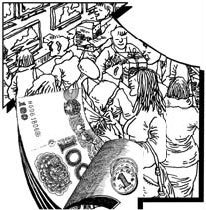
Updated: 2009-02-04 10:49 Premier Wen Jiabao expressed optimism about China's ability to battle the impact of the current global economic crisis and emphasized the importance for the world to maintain confidence against the crisis during his recent European tour. The Chinese leader's confidence was not groundless. The brisk shopping in consumer markets throughout cities and rural areas in the past "golden week" of Spring Festival was the best evidence of such confidence. According to the Ministry of Commerce, Chinese people spent a total of 290 billion yuan ($42.6 billion) shopping for the lunar new year celebration. More noteworthy is the fact that the spending was a 13.8 percent growth on the basis of the same period of last year although the global recession is also felt in this country. The optimistic mood was also demonstrated by more than 100 million tourists who traveled to domestic and foreign destinations during the seven days.
Chinese people are definitely not engrossed in a mood of blind optimism. They know the latent hazards; but they have not lost their basic confidence. This confidence stems from their understanding that the essential elements of China's economy have not changed and the development mode they have chosen in the 30 years of reform and opening-up drive has not changed. And the victories they achieved in 2008 overcoming the difficulties brought along by the unprecedented snow storms in January and earthquake in May and the successes of the Beijing Olympic Games and Chinese astronauts' space-walk all enhanced their confidence. Although they have complaints, as all people throughout the world do, the Chinese people have confidence in the government's ability to lead them in fighting the economic adversities.
This phenomenon may merit some thoughts on the part of certain Western politicians who always blame China from ideological perspectives. Why does a country adopting a social system diametrically different from the liberal capitalism they worship the most demonstrate a stronger confidence in the face of the worst economic crisis in seven decades? Why was a government which so often interferes in the market so successful in maintaining a fast economic growth for so many years? Why does a country that emphasizes collectivism more than individualism win such a strong trust from its people? In his speech delivered at Cambridge University on Monday, Premier Wen said: "This once-in-a-century financial crisis is truly thought-provoking. It reminds us of the need to have serious reflections on the existing economic systems and theories." He was right. Many Western economists have also begun to reflect on the drawbacks of the extreme liberal capitalism. In fact, the measures adopted by Western governments recently to bail out their battered economies were exactly administrative interference against the "intangible" market force - the core value of liberal capitalism. Different countries have different national conditions. What is successful in one country may not apply to others. Therefore, to battle the current world crisis, as Wen suggested, "countries should, first and foremost, run their own affairs well and refrain from shifting troubles onto others". (For more biz stories, please visit Industries)
|
永靖县| 苗栗市| 拉萨市| 新竹市| 乃东县| 丽江市| 天峨县| 邹城市| 法库县| 收藏| 洛川县| 株洲县| 淮北市| 曲阳县| 石渠县| 霍山县| 花莲市| 衡山县| 北安市| 永德县| 东台市| 马尔康县| 华安县| 酒泉市| 龙口市| 共和县| 齐齐哈尔市| 司法| 安阳县| 中宁县| 伊春市| 珠海市| 合水县| 鸡西市| 綦江县| 同德县| 柳林县| 宿松县| 惠州市| 安多县| 苗栗市|