BIZCHINA> Review & Analysis

|
BIZCHINA> Review & Analysis
|
|
Related
Challenges in building a low-carbon economy
By Hu Shaowei (China Daily)
Updated: 2009-01-07 11:58 The author is a senior economist with the State Information Center As global temperatures continue to rise, calls have been mounting worldwide for the development of a low-carbon economy (LCE). With global warming posing a looming threat to the world, how to contain it has become an overwhelming challenge to mankind. Beyond its relations with some natural factors, climate change is also closely related with human activities, particularly carbon dioxide emissions in the process of fuel burning. LCE refers to a low energy-consuming and low-pollution economy that has a minimal greenhouse gas emission into the biosphere. Relying on technological innovations, its development is mainly fueled by the use of renewable energy, ranging from solar power and wind power to hydropower. Due to a worldwide energy shortage and environment degeneration, an energy-efficient and environmentally-friendly LCE has been widely regarded as the world's third revolution after the Industrial Revolution and the information revolution. Its popularization is due to change the global economic track once again. Developing such an environmentally-friendly economy means that mankind must make unremitting efforts to pursue a new type of economic model that cares more about the combined effect in resources, energy and environment in the pursuit of a steady economic growth. Undoubtedly, this will bring about revolutionary changes to the world's current energy consuming structure, economic development model and mode of human behavior.
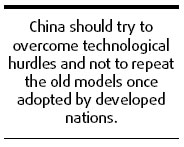
Since the adoption of the reform and opening up in 1978, China has also paid a high price in its resources and environment despite achieving a miraculous economic progress. The country's sustainable development has been increasingly threatened by its accelerating resources exhaustion, environment pollution and biological deterioration. Without fundamental changes to its past extensive economic growth model, it would be difficult for the fast-growing economy to carry on its high-paced growth. In a report delivered to the 17th National Congress of the Communist Party of China (CPC) Central Committee early last year, President Hu Jintao vowed to step up the country's efforts toward energy conservation and emission reduction and develop a circular economy. LCE, an emerging trend in the world's economic development, obviously remains one of the few options for the world's largest developing country to follow international practices. The country has taken an LCE development road and made its due contribution to the global battle against climate change. In June 2006, China promulgated a document formulating its policies toward global warming, the paper to make public its stance on this issue. The country has ever since taken a range of measures to join the world's fight against global warming. They include changing its economic growth model, adjusting its economic and energy structure, containing population growth and resorting to new and renewable energy technologies. The development of a low-carbon economy in China will not only help ease pressure on the country's rising energy demands and reduce its dependence on energy import, but will also help boost environmental protection. The development and popularization of low-carbon technologies will also help create more jobs in the country and sharpen its edge in the increasingly fiercer international competition. However, there still exist some difficulties on the way to a low-carbon economy. How to maintain a steady growth despite slashing greenhouse gas emissions remains one of the country's most difficult problems. Acquiring from developed countries the needed technologies is another challenge. A low-carbon economy is still in its experimentation stage and the cost of developing some of its technologies is still high. Compared with traditional ones, available LCE technologies are still at a disadvantage in market competitions. In particular, in China, a country whose natural resources mostly contain high carbon content such as coal, developing a low-carbon economy is even more complicated. No other nation in the world consumes coal at such a high ratio in its energy structure. In the traditional economy, the coal-dominant energy consumption structure enjoyed a certain advantage in international trade. However, this is not the case for a low-carbon economy. Gaining the initiative in the new round of global competitions that involve the development of a low-carbon economy and pulling itself out of the dilemma of the energy-consuming economic development are testing the wisdom of the Chinese people. Technological innovations turn out to be the only way out. China should try to overcome technological hurdles and not repeat the old models once adopted by developed nations. It should make great efforts to directly develop new low-carbon technologies and set up the mechanism and policy that can bolster the development of a low-carbon economy. This is the key to the country's future development. Otherwise, the scope for the country's development will be greatly limited and it would still lag behind others in the new round of international competitions. Thus, it is particularly necessary that in its efforts to develop a low- carbon economy, the country should redefine its core competitiveness and reconsider its strategies for national technological development, economic growth and promotion of international relations. (For more biz stories, please visit Industries)
|
龙游县| 平凉市| 固原市| 奇台县| 崇左市| 兰考县| 柳河县| 城市| 昌宁县| 诸城市| 卓资县| 申扎县| 武陟县| 泰来县| 神木县| 周宁县| 长武县| 南京市| 遵义市| 泰来县| 福泉市| 准格尔旗| 墨江| 新丰县| 彭水| 高青县| 禄丰县| 内丘县| 大悟县| 日喀则市| 汤原县| 舞钢市| 丹寨县| 永宁县| 朝阳市| 荆门市| 都匀市| 托里县| 克山县| 青阳县| 吉安县|