|
|
 |
 Raymond Zhou:
By jingo, they're mad!  Op Rana:
Consumerism and politics of waste   Ravi S. Narasimhan:
Lessons from SARS have to be applied  Alexis Hooi:
Beyond the death and destruction  The way we were
By Raymond Zhou (China Daily)
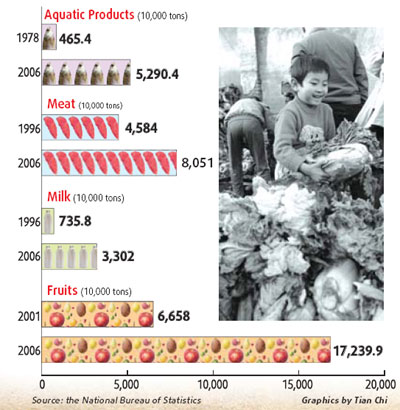
Updated: 2008-12-18 07:45 What we ate Food rationing was still in place in 1978. One would get up in the wee hours and stand in line for a thin slice of pork. Even if you had tons of money, you still ate a mostly vegetarian diet because most food items, except vegetables, required coupons. That was in the urban areas. In the countryside, meat was available only on rare occasions, such as the Chinese New Year, when households would slaughter a pig they had raised and feast for a week. Supermarkets did not exist back then. Instead, we had farmers' markets. In the small town where I grew up, the main street doubled as a farmers' market for a few hours every morning. If you got there at 10 am there would be only rubbish left. There were still traces of the old thinking that buying and selling between individuals was "bourgeois". I remember when I was in my early teens, an egg cost 7 fen (Chinese cents) or could be exchanged for a small bag of salt. You could not find beef or bananas in my hometown in Zhejiang before I left it in 1978. In northern China, the main diet was the so-called "coarse food", meaning anything except fine-grade rice and wheat. Steamed buns made from high-quality flour were available only on special holidays. In cities, they were still rationed but available more frequently. Moreover, before the era of greenhouses, fresh vegetables were hard to come by during the barren winter season. In cities like Beijing, residents would stack heads of cabbage like wooden logs along stairways and corridors, which would become so cluttered it would be difficult to walk by with a bicycle. Dining out was often a nightmare. The wait for a table was so long even the worst food would whet your appetite. You had to pay for the meal beforehand, so you could not back out. Service was an alien concept, but the few restaurants there were would post a notice of Do's and Don'ts for service on the wall. When Coca-Cola came to China, the reaction of local youth to the taste of this soft drink was captured in the 1986 movie A Great Wall, made by Chinese-American director Peter Wang: "Yuck, it has the tang of herbal medicine!" That was exactly what many of us said. Coke was an acquired taste, to say the least. The emergence of supermarkets in the mid-1980s was something of a black comedy. Although customers were allowed to touch the merchandise before purchasing, there would be shop clerks guarding every aisle lest you ran away without paying. By the 1990s, the age of scarcity had given way to the age of abundance. Ration coupons had been phased out completely. The big irony is, what used to be considered poor man's food is now considered a healthy diet, and being fat is no longer a sign of wealth, but rather, of a lack of exercise. Regional cuisine is not regional any more because you can savor any type of food in a sizeable city, not only from different parts of China, but from the rest of the world. There is both diversity and abundance. Now that China has turned into a paradise for epicureans, fashionable young women are boasting about how little they eat!
|
宝鸡市| 绥德县| 咸丰县| 金塔县| 定日县| 千阳县| 盐源县| 南城县| 壶关县| 石河子市| 张掖市| 罗田县| 常熟市| 同德县| 鹤山市| 东海县| 长阳| 富源县| 宁德市| 高雄市| 灵宝市| 吉木萨尔县| 宁陵县| 手游| 中山市| 长春市| 大足县| 开鲁县| 西华县| 福海县| 牡丹江市| 比如县| 侯马市| 泗水县| 府谷县| 长子县| 青神县| 隆德县| 哈尔滨市| 巴南区| 大姚县|