BIZCHINA> Bilateral Trade

|
BIZCHINA> Bilateral Trade
|
|
A pledge of free trade
(China Daily)
Updated: 2008-11-24 07:43 The strong support that leaders of the Asia-Pacific Economic Cooperation (APEC) gave to free trade will prove more than necessary for the world economy to eventually step out of the current crisis. All countries should join in the fight against protectionism. In a statement issued in Peru's capital, Lima, the 21 leaders of the APEC member economies endorsed the agreement to resist domestic pressures to protect industries, promising to refrain in the next 12 months from raising new trade barriers. And they also pledged to reach an agreement next month on the outlines of a World Trade Organization pact that collapsed in July after seven years of negotiations. Chinese President Hu Jintao stressed that we should have strong confidence in the multilateral trading regime and give strong support to the Doha Round negotiations. At this critical juncture when the rapidly-spreading global financial crisis is slowing world economic growth and giving rise to calls for protectionist measures, a successful conclusion of the Doha Development Round of trade talks becomes more important than ever. A fair and open multilateral trading regime will be conducive to the steady growth of regional and global trade. It is all too clear now that the ongoing international crisis has spread from some parts of the world to the entire globe, from developed countries to emerging markets and from the financial sector to the real economy.
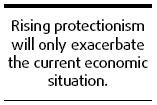
However, every cloud has a silver lining. Concerns over the global financial crisis are injecting new and much-needed urgency into the Doha round of trade talks. Billed as the "development round", a Doha global trade deal is supposed to help poor countries by opening markets to their exports and reducing rich countries' trade-distorting subsidies for agricultural products. But differences between the developing and developed countries over agricultural and non-agricultural market access have made the talks repeatedly miss deadlines since 2001. Now, the need of a strong boost to save the world economy from a deep recession should enable trade negotiators to overcome their differences. Otherwise, rising protectionism under domestic pressure will only exacerbate the current economic situation. As a long-term supporter for free and fair trade, China has demonstrated its resolution to fight protectionism in the face of the emerging global recession. Instead of taking every measure to revive its export sector, a key growth engine that was hit hard by the global economic slowdown, China has recently adopted even stronger measures to generate greater domestic demand. The central government has decided to invest an additional 100 billion yuan ($14.6 billion) this year to accelerate projects related to people's livelihood, infrastructure, the eco-environment and post-disaster reconstruction. And between the fourth quarter this year and the end of 2010, investment in these projects alone will reach nearly 4 trillion yuan ($585 billion). By expanding its domestic market, China will create a source of growth for itself and the world economy as well. To effectively address the current global financial crisis and economic slowdown, all countries should stand firmly against protectionism in order to allow free and fair trade thrive within and beyond their borders. (For more biz stories, please visit Industries)
|
分宜县| 读书| 历史| 怀来县| 黑河市| 开原市| 靖江市| 磴口县| 富川| 水富县| 金堂县| 济宁市| 岢岚县| 富宁县| 平昌县| 政和县| 枣强县| 玉林市| 宝应县| 富源县| 昌邑市| 朝阳区| 石棉县| 安庆市| 铜川市| 栾川县| 台东市| 平邑县| 皋兰县| 东明县| 灵武市| 永泰县| 乃东县| 苏尼特右旗| 彭泽县| 赫章县| 额尔古纳市| 台北市| 南京市| 西华县| 万山特区|