BIZCHINA> Center

|
BIZCHINA> Center
|
|
Nation 'can cope with downturn'
By Xin Zhiming (China Daily)
Updated: 2008-10-27 07:51
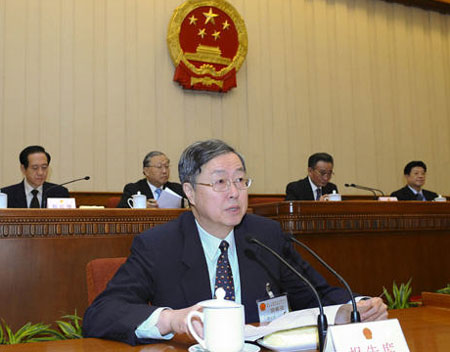
The fundamentals of the Chinese economy remain sound and the country can cope with the challenges posed by the worsening global financial crisis, central bank governor Zhou Xiaochuan told legislators Sunday. But "we must not underestimate the impact (of the crisis) on China's economy," he said while reporting to the fifth session of the Standing Committee of the National People's Congress (NPC).
Moreover, continuing urbanization and industrialization, which generate huge investment demand, as well as the large domestic market and low-cost labor, mean the basic economic growth track will not deviate much, he said. Lin Yifu, senior vice-president and chief economist of the World Bank, also said the impact from the global financial crisis on China would be "limited". In the era of globalization, no place is a safe haven but China's economic condition is one of the best compared with others, he said at Peking University on Saturday. China's GDP growth slowed to 9 percent in the third quarter from 10.1 percent in the second. As the global economy is expected to slow, China's growth may weaken further, although it may avoid a hard landing, economists said. At the NPC session Sunday, Wu Xiaoling, vice-chairwoman of the Financial and Economic Committee, sounded a cautionary note when responding to Zhou's report. She warned that in the next two or three years, China could face more difficult times than during the 1997-98 Asian financial crisis. Wu said the current situation is grimmer than a decade ago because the proportion of the country's exports to GDP is higher while the problem of overcapacity could lead to reduced investment in such sectors as steel and electricity generation. The real estate bubble has taken housing out of the reach of many while car sales meet the bottleneck of high oil prices and environmental constraints, she said. "It is challenging to boost economic growth by encouraging people to spend," she said. "We should get prepared for difficulties." The country has taken a slew of monetary and fiscal measures recently to boost growth, including two cuts in interest rates and banks' required reserve requirement, or proportion of money lenders must hold in reserve. Analysts said more policy relaxations could be in the offing if needed. "If there are signs of further economic weakening and sapping investor confidence, policymakers may further cut interest rates or the bank reserve requirement," said Ma Ming, economist with the Beijing Institute of Technology. But Wu - pointing to lessons to be learned from the US economy - warned that in the long term, it is not advisable to keep money costs low to stimulate the economy. Economists agree that low interest rates in the US during the past decade have sown the seeds for today's financial crisis. Zhou also said that inflation could rebound in the coming months and the central bank would keep a close eye on consumer prices. In September, inflation eased to 4.6 percent from a peak of 8.7 percent in February. (For more biz stories, please visit Industries)
|
清河县| 霍邱县| 南昌市| 安吉县| 青阳县| 宣化县| 瓮安县| 京山县| 宝清县| 海淀区| 绥宁县| 介休市| 炉霍县| 顺昌县| 平凉市| 兖州市| 芮城县| 梁平县| 丰镇市| 松潘县| 阿鲁科尔沁旗| 江都市| 蓝田县| 如东县| 长宁县| 迁安市| 镇平县| 靖边县| 平和县| 自贡市| 馆陶县| 南汇区| 贵港市| 新平| 肇东市| 遵义县| 保亭| 临沭县| 岑巩县| 汽车| 镇赉县|