BIZCHINA> Center

|
BIZCHINA> Center
|
|
Related
Analyst says decade of energy challenges ahead
By Fu Jing (China Daily)
Updated: 2008-09-16 09:36
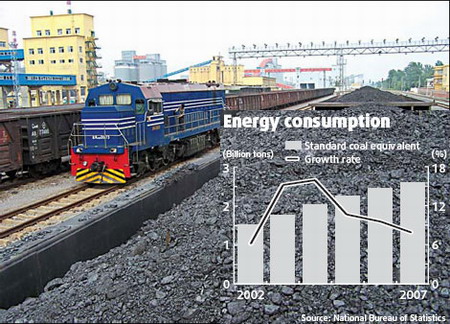
China's rapidly rising energy demand may ease off by 2018 when the nation is expected to have basically realized its industrialization and urbanization, according to a senior analyst. Speaking to China Daily, Chen Jiagui, vice-president of the Chinese Academy of Social Sciences, also warned of a "severe energy supply shortage" China may encounter if this coal-dependent country fails to accelerate its exploration of coal reserves and other energy sources. "We will encounter another decade of a tight energy supply-demand balance," Chen said. "Total energy consumption will continue to rise at a faster pace in China because more provinces will accelerate their industrialization," Chen said. Compared with international standards, out of China's 31 provinces, municipalities and autonomous regions, 24 have yet to become fully industrialized. In China's energy consumption mix, industrial development accounts for 70 percent. "At the early stage of industrialization, provinces will unavoidably consume more energy as they have to take off by developing heavy industry," Chen said. In addition, energy demand will be intensified, Chen added, as more rural Chinese become urban residents. The country aims to increase its urbanization rate to 60 percent by 2020 from the current 45 percent. Chen called for further measures to encourage businesses to conserve energy and stressed that China's energy strategy should prioritize thrift and rely on domestic resources. Statistics show domestic sources provided more than 90 percent of the country's energy needs, and its self-sufficiency rate was higher than Organization for Economic Cooperation and Development countries and the United States by 20 and 30 percentage points respectively. He warned that if China continued with the development model in place before 2007, it would double its energy consumption to 5 billion tons of standard coal equivalent from last year's 2.65 billion. However, if tougher energy-saving measures are implemented, China's energy consumption is forecast to reach 2.9 billion tons of standard coal equivalent in 2010 and 3.8 billion in 2020. "We cannot sustain the energy supply if the former scenario comes true," Chen said. "And we also cannot pay the environmental costs of burning increasing amounts of coal." As the world's second largest energy producer, China has relatively strong foundations in energy generation and supply, helping to maintain its economic growth at an average annual rate of 9.8 percent from 1980 to 2006. To complement these measures, the government is determined to increase the output of hydropower, nuclear and renewable energy by a large margin. The government expects renewable energy to account for 10 percent of the nation's total consumption in 2010, with the figure rising to 15 percent in 2020. The authorities have already taken measures to cut energy consumption per unit of GDP by 20 percent from 2006-10, with further reductions expected after 2010. Coal accounts for about 70 percent of the total consumption in the country's energy mix. Currently, only 145 billion tons of coal reserve can be extracted immediately despite official figures showing the country's coal reserve may reach 1 trillion tons.
(For more biz stories, please visit Industries)
|
德州市| 德化县| 建昌县| 朝阳县| 涿鹿县| 瑞丽市| 安乡县| 侯马市| 聂荣县| 九江县| 宽甸| 阿坝县| 石狮市| 密云县| 玉林市| 溧阳市| 尼玛县| 无锡市| 贡觉县| 太仓市| 曲水县| 二连浩特市| 泰宁县| 昌宁县| 建平县| 洪江市| 和田县| 浦东新区| 浪卡子县| 汉川市| 囊谦县| 右玉县| 信丰县| 株洲市| 迭部县| 定州市| 云霄县| 信阳市| 南部县| 子洲县| 苗栗县|