BIZCHINA> China Statistics

|
BIZCHINA> China Statistics
|
|
Economy grows 10.4%, inflation eases
By Dong Zhixin (chinadaily.com.cn)
Updated: 2008-07-17 10:45
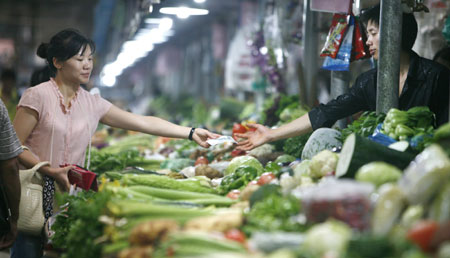
China's economy slowed down for a fourth straight quarter as inflation eased in June, official figures showed on Thursday, giving more ammunition to advocates for a looser monetary policy. The Gross Domestic Product (GDP) grew 10.1 percent in the second quarter after rising 10.6 percent in the first three months, said Li Xiaochao, spokesman for the National Bureau of Statistics at a press conference in Beijing. China's economic growth has been on a steady decline since peaking in the second quarter of 2007. NBS chief economist Yao Jingyuan said the double-digit GDP growth indicated China's economy was still growing at a steady and relatively fast pace. "The cooling of GDP growth indicated the government's macro-economic policy to prevent the economy from going overheated has paid off," said Yao. The slowing world economy and weaker demand on international markets also adversely affected the Chinese economy. Another widely watched indicator, the Consumer Price Index (CPI) -- an important measure of inflation, moderated to 7.1 percent in June after rising 7.7 percent in the previous month thanks to easing food prices. The combination of economic slowdown and easing inflation may give rise to louder calls for an ease in the monetary policy. Analysts said that the tight monetary policy put in place at the end of last year has brought about great difficulties for many firms, especially private ones. Thousands of small and medium enterprises have gone bankrupt in the coastal areas as they could hardly get loans from banks, reports said. Fast appreciating yuan value, rising cost of labor and raw materials are also key reasons for the situation. As the world's largest developing country, China needs fast economic development to maximize employment. However, any ease in monetary policy will be a tough call, in face of inflation pressure. "In spite of falls in the consumer prices in the last two months, the prices are still running at a relatively high level," Li Xiaochao said. "We will continue to prevent prices from rising too fast and curb inflation." Adding to the price pressure, the Producer Price Index (PPI) continue to jump, rising to a three-year high of 8.8 percent in June over a year earlier after increasing 8.2 percent in the previous month. The PPI measures the prices at the factory gate level and is usually used to predict future CPI level, as retailers or manufacturers will eventually pass the rising cost to consumers. Inflationary expectation is also a major concern. "With the rapid price increases in the global market, the public will have expectations for further price rises, " according to Li. If consumers expect prices to rise, they will ask for pay increases, or rush to buy products, thus exerting further upward pressure on prices. Li also cited the recent petrol and electricity price increases, as well as post-quake construction which will increase the demand for building materials. These concerns may be part of the reasons why the finance committee of the National People’s Congress, China's parliament, pledged on Wednesday to maintain its tight monetary policy for the rest of the year. However, watchers sensed a softening of words in its description of the fight against inflation. The committee said curbing price pressures would be a "prominent task" in the months ahead, instead of "top priority," phrasing that economic leaders repeated in the early months of 2008. Analysts believe policy makers are trying to find a balance between inflation and economy growth and are gradually shifting towards preventing a major economic slowdown. (For more biz stories, please visit Industries)
|
德清县| 漾濞| 祁门县| 遂溪县| 瑞金市| 太和县| 翁牛特旗| 宝清县| 鄂温| 黑水县| 孟津县| 扎兰屯市| 门源| 英山县| 克什克腾旗| 阿荣旗| 泾阳县| 金溪县| 金秀| 南澳县| 阳城县| 炎陵县| 武强县| 开江县| 兴安盟| 德保县| 温泉县| 广德县| 大渡口区| 兰西县| 潮安县| 香港| 兖州市| 汉沽区| 桐柏县| 陇西县| 新巴尔虎右旗| 刚察县| 开鲁县| 肥城市| 巴塘县|