BEIJING -- No country has experienced such a fast and stable growth over the past three decades as China.
Its economy has expanded at an annual rate of 9.7 percent since 1978 - almost three times as fast as the world average - and has maintained double-digit growth in the past four years.
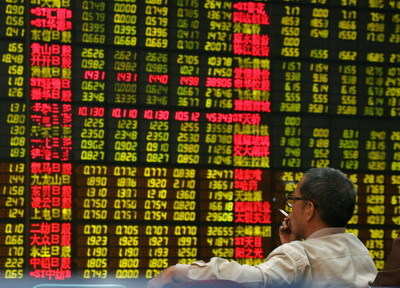
A man sits in front of an electronic board at a stock exchange in Tianjin municipality, October 12, 2007. [Agencies]
|
An 11.5-percent growth in the first half of this year took China closer to overtaking Germany as the world's third largest economy, with its 1.3 billion people well on track to enjoying "a well-off society of a higher standard", as portrayed by the Communist Party of China (CPC).
The most populous nation is in the fast lane. Its per capita GDP hit 800 US dollars in 2000 when "the people became well-off by and large", according to the Communist Party Congress report in 2002. The nation then took two years to raise the figure to 1,000 dollars, and another four years to 2,000 dollars.
The figure will top 3,000 dollars by 2020, according to a plan put forward at the 2002 Party Congress.
"The day will come sooner than expected as the current growth is faster than the annual average of 7.2 percent necessary for the realization of this goal," said Zhuang Jian, an economist with the Asian Development Bank.
The blistering rate of economic growth alone, however, does not ensure "a well-off society of a higher standard".
"The well-off life we are leading is still at a low level; it is not all-inclusive and is very uneven," the People's Daily said in a commentary earlier this year.
"We must be aware that China is in the primary stages of socialism and will remain so for a long time to come," it added.
Thanks to the economic takeoff, the Chinese leadership has been able to further promote the welfare of the common people. It has recognized the need to narrow the gap between the rich and the poor and to lift tens of millions above the poverty line.
A medical insurance system, recently launched in 79 cities as a pilot project, will benefit all urban residents by 2010, while a minimum living allowance system is under development to cover the vast countryside.
To reduce financial burdens on farmers, China abolished the 2,600-year-old agricultural tax, exempted rural students from tuition fees for nine years of compulsory education and introduced a medical care scheme, under which the government helps fund farmers' medical expenses.
From 2002 to 2006, the per capita income of Chinese farmers has risen by an annual average of 6.2 percent. For the first time since 1985, the growth rate has exceeded 6 percent for three straight years.
But the gap is still widening. The income of urban residents in 2006 was 3.28 times that of rural ones, up from 3.22 in 2005 and 3.21 in 2004. "Farmers have been getting rich fairly fast, yet still more slowly than urban dwellers," said Vice-Minister of Agriculture Yin Chengjie.
With the economic growth no longer the top priority, the government has focused its macro-control policy on energy conservation and emission reduction in order to enhance harmony between man and nature and ensure sustainable development.
To produce 5.5 percent of the world's GDP, China currently uses 15 percent of the world's coal consumption, 30 percent of the world's steel and 54 percent of the world's cement.
The past five years also saw improvements in socialist democracy and the legal system, with people's interests better respected and lawmakers soliciting public opinions for major laws on property protection and personal income tax.
Last month, the Beijing government held a public hearing to give the public a real say on cutting subway fares.
Two options were proposed: two yuan (0.27 US dollar) for each ticket or a flexible scheme ranging from two yuan to four yuan.
The first one, obviously cheaper for commuters, won the favor of a majority of the attendants and was adopted by the government.
"It will cost the government an additional 1 billion yuan a year but we must respect the decision made by the public," said Zhou Tianyong, deputy director of the Research Office of the Party School of the CPC Central Committee.