China not a manipulator, US Congress is
By Caroline Baum (Bloomberg)Updated: 2007-06-19 10:59
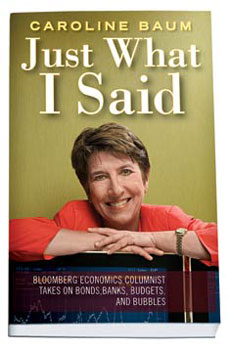
Caroline Baum, author of "Just What I Said," is a columnist for Bloomberg News. The opinions expressed are her own
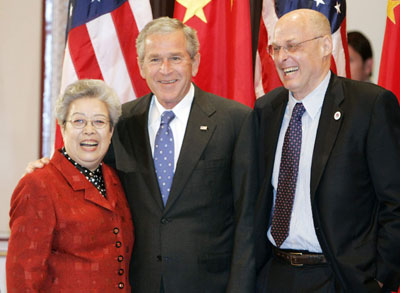 U.S. President George W. Bush (C) and U.S. Secretary of Treasury Henry Paulson (R) welcome Chinese Vice Premier Wu Yi to the Eisenhower Executive Office Building in the White House complex before a meeting of the U.S.-China Strategic Economic Dialogue in Washington, May 24, 2007. [Reuters] |
China may not qualify as a currency manipulator, according to the terms set out in Section 304 of the Omnibus Trade and Competitiveness Act of 1988. Not to worry: The U.S. Congress is happy to fill those shoes.
In its semiannual report on International and Exchange Rate Policies last week, the U.S. Treasury declined to tag China, which manages its currency, the yuan, to the dollar, with a scarlet "M."
"Treasury was unable to determine that China's exchange rate policy was carried out for the purpose of preventing effective balance of payments adjustment or gaining unfair competitive advantage in international trade," according to the report.
 |
On the same day that Treasury was punting on name calling -- preferring, instead, a Strategic Economic Dialogue between the two countries -- four U.S. senators picked up the ball, introducing legislation that would make it easier for American companies to seek redress under anti-dumping laws.
"For too long our currency policy has left American workers and businesses unprotected from foreign governments seeking an unfair financial advantage," said Senate Finance Committee Chairman Max Baucus, Democrat of Montana, one of the bill's sponsors.
In case the good senator hasn't noticed in his 32 years in Congress, the U.S. has no currency policy. And as for getting China to adopt a more flexible exchange rate, anything Congress does will probably be counterproductive. Sovereign nations don't like to be seen caving in to pressure from other countries.
Win-Win Situation
"What country has changed as much as China in the last 30 years in terms of opening its markets?" said Dan Griswold, director of the Cato Institute's Center for Trade Policy Studies in Washington. "And how much has the U.S. benefited? The whole debate is based on a false notion of mercantilism. You can't realize real gains through currency manipulation."
In the Asian financial crisis in 1997, "some currencies practically dropped 40 percent overnight," Griswold said. "It didn't create prosperity."
China was singled out and praised for maintaining its peg to the U.S. dollar.
Two of the other sponsors of the Currency Exchange Rate Oversight bill,
Republican Lindsey Graham of South Carolina and Democrat Chuck Schumer of New
York, are back for their second China go-round. Last year, the duo sponsored
legislation that would have slapped tariffs of 27.5 percent on Chinese imports.
They withdrew the bill when it became clear that it wasn't compliant with World
Trade Organization rules.
| 1 | 2 |  |
(For more biz stories, please visit Industry Updates)