Center
Trade balance a sticking point
By Ding Qingfen (China Daily)
Updated: 2007-04-14 06:57
 |
Large Medium Small |
China's rapid economic rise has received a great deal of attention worldwide. Last year's record trade surplus prompted sharp criticism, especially from the United States and the European Union.
In 2006, China's trade volume grew to more than $1.76 trillion, an increase of 23.8 percent on the previous year. The trade surplus shot up to over $177.47 billion, growing by more than 74 percent compared to 2005.
This has heightened trade frictions and disputes. Most recently, the US imposedtariffs on two Chinese makers of high-gloss paper on March 31, claiming China was "illegally" subsidizing some of its exports.
The measure antagonized the Chinese government, which expressed strong opposition to the duties and called for the US to reconsider its decision.
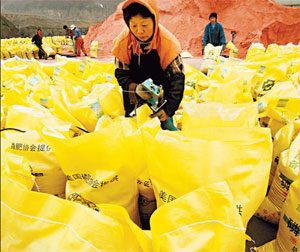
A worker unloads fertilizer imported from the United States in the port of Lianyungang, East China'sJiangsuProvince, on April 1. [China Daily] |
Trade frictions between China and other economies are expected to remain acute this year, according to a report by the Chinese Academy of Sciences.
To address the situation, the government has issued regulations to promote imports of hi-tech, electronics and machinery products.
The Chinese government is reportedly planning to purchase products worth $17 billion from the United States from April to May in a bid to reduce its trade surplus with the US. This comes after last April's $16.2 billion purchasing contract from the US, the largest of its kind for China.
Analysts said trade exchanges with Western and Asian partners involving hi-tech services and solutions, tertiary industries and the luxury sector will be crucial in developing China's imports.
Since the China-ASEAN FTA (Commodities) was signed in November 2004, the two regions have seen robust growth in trade, and signed a service trade agreement in January.
"China-ASEAN trade will grow beyond previous commodities to service sectors like finance, telecommunications and tourism, which is more beneficial for ASEAN," said Lu Jianren, a senior researcher at the Chinese Academy of Social Sciences.
The shift is also the case for China-Japan trade.
"From this year, there will be an adjustment in Japanese exports to China, with enterprises bringing in more advanced manufacturers and technologies and more companies in service industries delving into the market," said Makoto Isogai, chairman of the Japanese Chamber of Commerce and Industry.
The European Union is leading the way as China's biggest hi-tech product and service exporter, followed by Japan and the United States.
EU members are active practitioners. Annick de Kermadec-Bentzmann, president of the French Chamber of Commerce and Industry in China, said services from France like luxury consumer services, logistics and financial services would play a significant role in balancing trade between the two countries.
But not everyone agrees.
The United States, which holds the biggest deficit with China, worth $144.26 billion in 2006, still has many restrictions on hi-tech exports to China.
(China Daily 04/14/2007 page2)
| 分享按鈕 |