'Opening-up to continue'
Updated: 2011-12-12 07:56
By Ding Qingfen and Yu Ran (China Daily)
|
|||||||||||



|
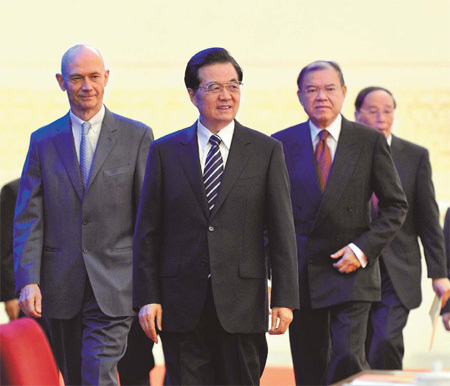
President Hu Jintao, followed by World Trade Organization (WTO) Director-General Pascal Lamy (left) and the United Nations Conference on Trade and Development Secretary-General Supachai Panitchpakdi, attends a forum marking the 10th anniversary of China's entry into the WTO in Beijing on Sunday. [Photo / Xinhua] |
|
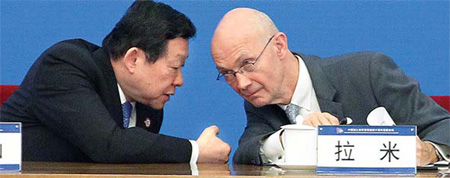
Minister of Commerce Chen Deming (left) talks with Pascal Lamy, director-general of the WTO, at a forum marking 10 years since China's entry to the WTO in Beijing on Sunday. [Photo?/ China Daily] |
President addresses forum marking decade of progress since WTO entry
BEIJING / SHANGHAI - When China joined the World Trade Organization (WTO) 10 years ago it opened up many of its sectors for the first time and embarked on a journey that would lead to it becoming the world's second-largest economy within a decade.
That journey will continue for the benefit of both China and the world, President Hu Jintao said on Sunday.
"China will follow a more active opening-up strategy," Hu said at a forum in Beijing to commemorate China's entry to the world trade body.
China has fully met its commitments to the WTO since it joined the trade body on Dec 11, 2001, Hu said, citing a number of statistics.
Tariffs, in general, had fallen to 9.8 percent from 15.3 percent, far lower than the average for developing nations. It has also opened up 100 service sectors, a figure close to the level for developed nations.
It is now the world's second-largest trader and the largest exporter. The nation's accumulative imports in the past decade reached $7.5 trillion while it attracted foreign direct investment of $759.5 billion.
"The commitments accepted by China as part of its entry into the WTO were very high. In fact, many went well beyond what other emerging economies accepted in the past," Pascal Lamy, director-general of the WTO, said at the forum.
WTO membership made China a world investment destination and Shanghai was one of the cities that benefited from that trend, said Song Xiaohui, an official with the Shanghai SME Development and Service Center.
"As China's financial hub, Shanghai has seen its industries and sectors develop over the past 10 years," Song said.
Hong Kong also reaped benefits.
Lillian Tsoi, a certified accountant in Hong Kong, said the city's professional service sector gained the most. "Demand for accounting and auditing services grew rapidly thanks to more and more mainland firms going public in the city."
The number of mainland companies that listed in Hong Kong increased to more than 600 from around 90 in 2001, according to Hong Kong Exchanges and Clearing Ltd, the holding company for the stock exchange.
WTO entry has also resulted in global benefits.
"There can be little doubt that the accession of China to the WTO has brought about a significant transformation for China, for the rest of the world and for the multilateral trading system," said Supachai Panitchpakdi, secretary-general of the United Nations Conference on Trade and Development.
In the past decade, with annual imports of about $750 billion on average, it helped boost the global job market.
"China will unswervingly commit to the opening-up strategy to help itself grow and promote global development," Hu said.
The development of green and energy-saving industries, as well as agriculture and culture, will be promoted, Hu said.
China is seeking to transform its growth model in the coming years by developing the high-tech and service sectors. It wants domestic consumption to replace exports as the major growth engine.
The shift follows rising costs and a weakening world economy that has seen a reduction in demand for Chinese exports.
Naoyuki Shinohara, deputy managing director of the International Monetary Fund, said reforming the economic model is an urgent task.
"Now is the time to continue with the remarkable track record by accelerating domestic reform to raise the income of Chinese households, boost consumption, and strengthen the growth and development of the service sector.
"Such a transformation should also benefit the world, as China becomes an even more important export destination for an expanding range of countries."
According to studies by the World Bank and other international institutions, China has the potential to quadruple per capita income to about $16,000 and become the world's largest economy by 2030.
But World Bank Vice-President Otaviano Canuto cautions that achieving these goals will mean that challenges have to be overcome.
"China needs to overcome emerging new challenges, adapt its growth model to avoid the middle-income trap, reduce its large trade surpluses to mitigate tensions with trading partners and increasingly play an active leadership role in global forums and multilateral institutions."
George Ng in Hong Kong contributed to this story.
Related Stories
China's accession to WTO worth celebrating 2011-12-12 08:00
Benefits of membership 2011-12-12 08:00
Global business shares fruits of WTO accession 2011-12-12 07:58
Firms gain growth from entry 2011-12-12 07:58
- Organic food gaining popularity
- European gloom causes credit squeeze
- Surveys reveal sharp global slowdown
- Luxury brands eye record numbers
- Fiscal revenue growth slows to 10.6%
- Dongfeng to triple own-brand vehicle sales
- A wealthier China shapes global luxury landscape
- C919 passenger jet starts development phase