All for one, one for all
Updated: 2011-12-09 15:51
By Fu Jing (China Daily)
|
|||||||||||


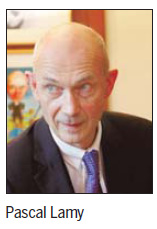
When China joined the WTO in 2001, it was a move that transformed both China and the world, says Pascal Lamy, director-general of the WTO. Lamy said he feels that "China is a success story that is still unfolding".
Over the last 10 years, China has become the world's biggest exporter and also surpassed Japan in 2010 as the world's second-biggest economy. The nation's trade and investment have also helped create millions of jobs all over the world during past 10 years. Trade deficit is expected to remain stable over the next five years, even as imports are set to surpass $10 trillion during the 2011-2015 period.
Lamy, however, does not rely on these numbers to support his arguments. "The win-win situation (after China's WTO entry) is a sum of pluses and minuses," says Lamy who has steered the WTO ship from 2005 after leaving the European Commission.
"Much of China's WTO experiences can be summed up in reforms and global trade expansion. Though this was achieved through marathon negotiations, there are some who are not happy with the outcome. But it is only a natural consequence in trade opening," Lamy says.
"By joining the WTO, China has paid a price but in return, it has improved the rule of law, efficiency, transparency and market access."
But the WTO chief also admits that the period of rapid economic growth and social reform has also seen turbulence.
"The transformation has led to turbulence that needs to be managed both within and outside China, thereby enhancing the political difficulties. Changes often transform the political and social fabric of a nation. In other words, it has led to difficulties that can be fixed only with proper policy changes. This is what is happening in China and the rest of the world," he says.
But despite these turbulences, Lamy said he feels that "overall China has played a responsible role in the WTO regime".
Lamy says that China has contributed to the system by opening up its economy, improving the stability, predictability and transparency of a number of rules that favor trade and economic activities, even as it enhanced employment and growth.
"That is where we started. We are in the business of growing the pie through efficiency improvement and that is what economic growth is all about. Economic growth is a sum of the improvement of efficiency. So, in that sense, this has worked," says Lamy.
"Of course, it has come with its own costs and problems. This is because the system needs to be adjusted through reform either within China or in other part of the world."
China, in any case, is a specific instance, because of the size of the economy and its speed of growth. It is unprecedented that such a sizable economy has developed in human history with such a rapid growth rate.
"That is why China is different from other emerging economies, like India, Indonesia and Brazil," says Lamy.
"If you look at China 20 years from now, it (China) will be 20 percent of the global economy, whereas India will be just 5 percent".