Lenovo ready for the big league
Updated: 2011-12-09 08:10
By Tuo Yannan (China Daily)
|
|||||||||||


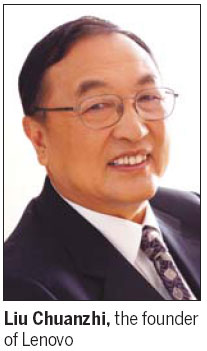
Lenovo Group, the largest Chinese PC maker and the second-largest globally, was one of the first Chinese companies to enter the global market and compete with overseas brands. Liu Chuanzhi, the founder of Lenovo, admits that China's entry into the World Trade Organization (WTO) fast-tracked Lenovo's internationalization process.
Liu set up Lenovo in 1984, with a team of 10 scientists and initial funding of 200,000 yuan ($31,489), at Zhongguancun in Beijing. "At that time, China's economy was still in its planned economy stage. All enterprises and government departments were required to purchase a local brand named Greatwall (for their computing devices), which did not have good quality," said Liu, who is now chairman of Legend Holdings.
During its initial stage, Lenovo was a very small computer company and did not have strong brand recognition. After China adopted the reform and opening-up policy, Lenovo slowly began to build its own brand image. After China joined the WTO in 2001, the Chinese government reduced tariffs for industries such as personal computers and telecommunications and opened the market to outside competition.
"Two things contributed to Lenovo's success," said Liu. "One is the management team that had an international and open mind, while the other was localization."
Many international PC enterprises, such as Hewlett-Packard Corp and International Business Machines Corp (IBM), had entered the Chinese market by then and brought in new products. Increased competition led to the birth of Chinese companies such as Lenovo, Huawei Technologies Co Ltd and ZTE Corp, which have moved beyond the domestic market and are now expanding to foreign markets.
When the company first started, Lenovo took the first steps by developing a Chinese operating system. "After that, we realized that we had the home-field advantage in China. As a Chinese company, we knew our market," he said. However, sales were still affected due to the market opening-up and China's WTO entry.
In 1994, when the company was facing its tipping point in the Chinese market, Liu appointed Yang Yuanqing as head of the company's PC business in order to further penetrate the market. Before China entered the WTO, personal computers were a luxury in the country, with the consumers predominantly government bureaus and large companies, Liu said.
After more domestic and overseas competitors entered the market, IT products and services gradually became affordable for Chinese people.
"We saw demand in the consumer market, while most of our overseas competitors were still focused on the corporate sector. So we released a desktop that cost below 10,000 yuan, targeting the consumer market," Liu recalled.
The new product was a big success in the Chinese market and Lenovo has been recognized as China's best-selling PC brand since 1997. After it became the market leader in China, Liu realized that he needed to build up an international team to compete in not only the domestic market, but overseas as well.
In 2005, Liu and Yang led one of the boldest moves in corporate history with the acquisition of IBM's PC Division. Nobody was optimistic about the merger, Liu said, adding that many people described his action as "a snake hoping to eat an elephant".
In order to transform Levono into a global company, the purchase was a step that had to be made, Liu said.
"The IBM move also provided valuable experience and knowledge for going global," he said.
Following the merger, the company redesigned its business in 2009 into two go-to-market organizations: One focused on developed markets such as the US and Japan, while the other was for emerging markets.
In January, 10 years after China entered the WTO, Lenovo announced a $175 million joint venture with Japan's NEC Corp, while in July, it acquired Medion AG, a German multimedia and consumer electronics maker. Following the successful deals, the company is now a $21.6-billion personal technology company and the second-largest PC maker in the world, serving customers in more than 160 countries and regions.
The company's latest quarterly report for the period ending Sept 30 showed an 88-percent year-on-year gain in net profit to $143.9 million, while revenue rose 35 percent to $7.79 billion.
"Entering the WTO has brought many challenges to Chinese enterprises, but I think they are overshadowed by the opportunities. I believe more and more local companies will embrace the opportunities to go abroad," Liu said.