


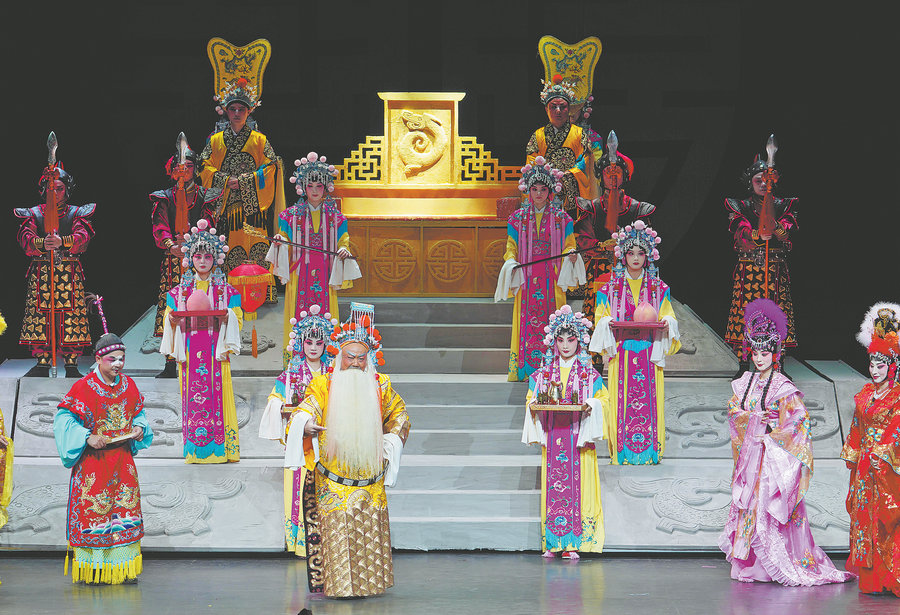
NANCHANG — William Shakespeare's King Lear is usually staged in London's West End or New York's Broadway. But on a night in Leping, Jiangxi province, a county-level city in East China's Jiangxi province, the tragic king reappears as Li Er, reimagined through Ganju, a centuries-old local opera.
Backstage, 51-year-old actor Hu Haidong brushes gold powder across his brow and adjusts his dragon-embroidered robe. As the piercing notes of Ganju Opera rise, Shakespeare's tragedy unfolds anew through high-pitched singing, stylized gestures and the rhythms of Chinese regional opera.
Also known as Jiangxi Opera, Ganju Opera dates back more than 500 years. Known for soaring vocals, martial movements and ornate costumes, it was listed as national intangible cultural heritage in 2011.
Leping is one of Ganju's cradles, with more than 400 preserved ancient opera stages across its villages and towns. At its core is the Leping Ganju Opera Troupe, which has long trained performers and sustained the tradition on rural and urban stages.
Hu grew up in this world. Born into a family of performers, he began learning from his father at 13 and later joined the troupe. But his career was not uninterrupted. Like many traditional operas, Ganju struggled in the late 20th century as audiences aged, markets shrank and rigid management stifled growth.
"I saw no future back then. It felt like the old art was fading," Hu recalls. "The pay was almost the same whether we performed once or 10 times."
In 2005, he left for Hainan province, spending years working in banana fields. He never expected to return to the stage.
The turning point came around 2012, when local authorities restructured the troupe into a more market-oriented company. Artists gained greater freedom to choose repertoire, adapt scripts and respond to audience demand.
"We returned creative initiative to the performers and let the market test their work," says director Cheng Hui. "The pressure to survive became a driving force for innovation."
One of the troupe's boldest experiments was adapting Shakespeare's King Lear into a Ganju production.
In this version, the story unfolds in a fictional ancient Chinese dynasty. The king becomes Li Er, a name echoing Lear while rooted in Chinese tradition. Core themes of loyalty, filial duty and betrayal remain, expressed through Ganju's vocal style and symbolic movement.
For Hu, this production was more than just a new role. It reignited his faith in the art form he had once left behind.
"I wanted to see whether our opera could truly carry Shakespeare's story," he says.
It did more than that. Since premiering in 2024, King Li Er has drawn audiences in both rural communities and city theaters, showing that a traditional local opera can still resonate today. Performers also benefit, with income now tied to performance frequency and audience response.
The revival extends beyond a single production. In 2014, the troupe launched a youth training program to cultivate new performers. It has also explored ways to reach younger audiences, from school activities to livestreaming performances.
These efforts are paying off. "I used to think opera was slow and hard to follow," said 17-year-old Peng Xin after watching King Li Er. "But this story drew me in. The costumes were stunning, and I could feel the king's pain."
The production has also gained international attention. Last October, Leping's King Li Er shared the stage with a British King Lear, offering audiences a rare chance to experience the same story through different traditions. British actor David Gareth, who played Lear in the British version, called it his first real encounter with the emotional power of Chinese regional opera.
Policy support has boosted Ganju's revival, with efforts focused on talent training, creative adaptation and integration with modern cultural industries.
Chen Li, a professor at Nanchang University and a national inheritor of Ganju, says traditional opera must preserve its core while connecting with modern audiences through innovation, young talent and digital platforms.
For Cheng, that defines the path ahead. "We will continue reviving endangered classics, refining innovative productions like King Li Er, and creating new works rooted in contemporary life for younger audiences," she says.
Talent development remains central. Veteran performers like Hu now mentor actors born after 2000, while partnerships with universities aim to link academic training with stage practice.
Today, the troupe stages more than 600 performances a year, many on ancient rural stages scattered across Leping. Amid carved beams and weathered pillars, Ganju remains part of everyday life even as it evolves.
During peak season, Hu performs for four or five hours a day. His voice turns hoarse, sweat streaks his makeup — yet he stays onstage with renewed purpose.
"When I hear the applause," he says. "I know the art is still alive, and I made the right choice coming back."





