New Year art draws on town's colorful tradition









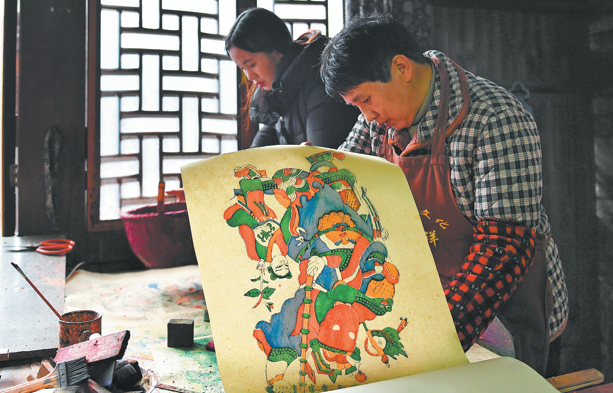
As the Chinese calendar ushered in layue, the 12th month, on Monday, preparations for the Chinese New Year began in earnest. In Tantou, a quaint town in Hunan province, this season is marked by the creation and display of vibrant nianhua, or New Year paintings, a tradition that breathes life into the community's cultural tapestry.
Visitors strolling through Tantou during the festive period are greeted by a spontaneous exhibition of art. Many doors become a canvas showcasing vivid depictions of gods of fortune, tigers with flamboyant stripes, and whimsical scenes such as mice in wedding processions.
These artworks, however, are more than mere decorations. They are talismans believed to ward off misfortune and invite prosperity, a custom deeply rooted in Chinese New Year celebrations.
Tantou nianhua, with a history of more than three centuries, are renowned across China for their radiant colors and expressive designs. This acclaim has earned Tantou the title of "Hometown of Modern Folk New Year Paintings". The esteemed writer Lu Xun (1881–1936) nostalgically recounted in Dawn Blossoms Plucked at Dusk, a collection of his essays, how a Tantou nianhua depicting a "mouse wedding" had adorned his bedside during childhood.
The meticulous craft of creating nianhua is beautifully captured in a recent documentary series, Ancient Crafts of Hunan, that was aired on Mango TV, which is based in Changsha, the capital of Hunan. The series employs macro lenses and slow-motion cinematography to delve into the intricate process behind the artworks.
What makes Tantou nianhua truly exceptional is the comprehensive, local production process, in which every step, from papermaking to the finished artwork, is completed in the town. This self-contained production cycle is a rarity in the world of nianhua and underscores the deep-rooted cultural and artistic heritage of Tantou.
The process begins with the crafting of the paper itself, using locally sourced bamboo. This paper, known for its flexibility and unique texture, forms the perfect base for the vibrant prints.
The heart of Tantou nianhua lies in its woodblock carving, a skill that demands precision and artistry, and is particularly renowned for its "steep knife upright line" technique. This method involves carving with a consistent angle and controlled pressure, ensuring that the lines remain steady and precise even at intersections and turns — skills that rely on the artisan's intuition and expertise.
Artisan Liu Guoli said the delicate art of woodblock carving requires focus and inner calm.
"Your personality and temperament shape the carving, making each block unique," said Liu, a national-level intangible cultural heritage inheritor of Tantou nianhua.
The vibrant palette of each nianhua is achieved through a multistep printing process, by which each color corresponds to a separate woodblock. These blocks are inked and pressed onto paper in layers, culminating in a final block that outlines the image with defining lines. The characters' facial features, such as eyes, cheeks, lips and beard, are then painted by hand, infusing them with lifelike detail.
Tantou nianhua, which in 2006 became one of China's first entries inscribed on the national intangible cultural heritage list, are celebrated for their bold and vivid colors. The palette, featuring tangerine reds, brilliant yellows and rose pinks juxtaposed with cool cyan and deep charcoal, creates a dynamic interplay of hues that imbues each piece with fiery vitality.
"The motifs and symbols in these nianhua represent a practical aesthetic shaped over centuries by countless families," said Wu Yuqing, a professor at the Fine Arts Academy of Hunan Normal University."The more deeply art is rooted in the lives of ordinary people, the more vibrantly its brilliance can unfold."
xingwen@chinadaily.com.cn



- 21 civil servants face punishment over fatal 2024 coal mine accident in China's Yunnan
- China expects record-breaking inter-regional trips in Spring Festival travel rush
- China to send 2 giant pandas to Munich zoo under 10-year conservation program
- People celebrate farmers' New Year in Shigatse, China's Xizang
- Rule to standardize TCM assessments
- Taiwan-US trade deal slammed as 'sellout'