



Ancient script gets upgrade for digital age









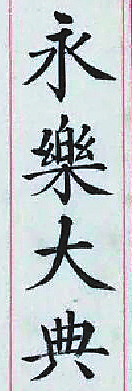
A style of calligraphy once used to record one of ancient China's most ambitious scholarly projects is being brought back to life — not on silk or paper, but on screens, posters and mobile phones.
In Guangzhou, Guangdong province, on Friday, Chinese cultural institutions unveiled a newly developed digital font based on the script of the Yongle Dadian, a vast encyclopedia compiled more than 600 years ago during the Ming Dynasty (1368-1644). The two-year project aims to transform a historical writing style once reserved for the imperial court into a typeface available for public use.
The Yongle Dadian, commissioned by the Yongle Emperor in the early 15th century, is regarded as the world's first encyclopedia. Compiled by leading scholars, it brought together classical texts spanning history, philosophy, literature, science and the arts. Its millions of characters were handwritten in a formal style of regular script prized for its clarity and discipline. Much of the original work has since been lost, making surviving volumes culturally invaluable.
Designers said their task was not simply to digitize old characters, but to preserve the movement and balance of brushwork in a format suited to modern reading habits.
"The challenge was adapting a script written for vertical pages to today's horizontal layouts, without losing its character," said Wang Wen, Foundertype design director of Beijing Founder Electronics Co, the company behind the font's development. "Proportions, weight and spacing all had to be rethought so the typeface feels natural on screens, while still carrying the elegance of Ming calligraphy."
The resulting font includes more than 42,000 characters, covering simplified and traditional Chinese, as well as Latin letters, numbers and s ymbols. Designers extracted 32 core brushstrokes from the original manuscripts and used them as modular elements, assembling new characters while maintaining stylistic consistency.
Cultural historians see the project as part of a broader shift in how China is approaching the preservation of its written heritage. "Traditionally, this script was protected by being kept out of everyday use," said Zhang Weitao, head of the Guangzhou branch of the China National Archives of Publications and Culture. "Now the aim is to let people use them, so they remain alive."
"Chinese characters are a cultural gene engraved in the bloodline of the Chinese people, and they form the core code that has ensured the unbroken continuity of Chinese civilization for over five millennia," he said.
That approach is reflected in the project's licensing model. Alongside the launch, organizers announced a public-interest plan allowing government bodies, media organizations, non-profits and individuals to use the font free of charge for noncommercial purposes. More than 50 institutions have already received authorization.
The font has begun appearing in exhibitions, publications and cultural products. One of the first adopters, Guangzhou Art Museum, has used it in a calendar project.
"The typeface is a visual gene of civilization," said Luo Qi, director of the museum. "When people encounter it in daily objects, they're not just seeing history — they're participating in it." Wang said they are also preparing a mobile version, which will allow users to use the font directly on smartphones. The mobile release is expected within weeks.
Zhao Yang, editor-in-chief of South International Communication Center, said the typeface is more than a design innovation. By combining the grandeur of Ming Dynasty calligraphy with digital technology, it bridges tradition and modernity — a sign of a broader shift in the approach to cultural heritage, where preservation comes through active use by anyone who types, reads or designs.
Xie Ruiqi contributed to this story.
Contact the writers at zhengcaixiong@chinadaily.com.cn


- Seven dead, 12 hurt as vehicle rolls over in Yunnan
- Purple sea of?catnip flowers?blooms in Shandong town
- 'Blue tears' turn Fuzhou's beaches fluorescent
- China-made marine-derived antitumor drug to begin combination therapy trials soon
- Wild apple trees create a poetic spring landscape in Xinjiang
- Tianjin town plays leading role in global instrument trade





