



Bamboo slips tell stories of ancient eras
2 techniques to restore waterlogged records pioneered by Jingzhou center









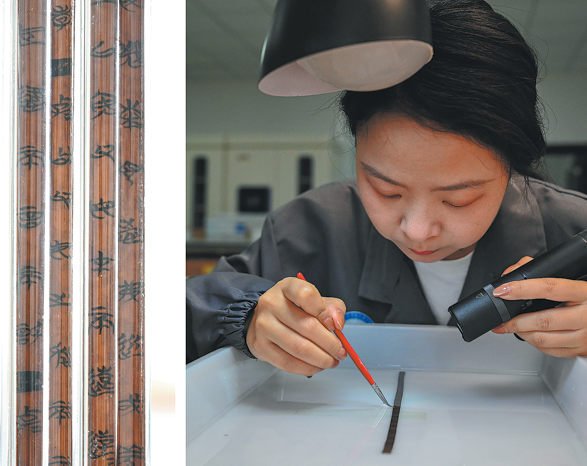
When unearthed, ancient bamboo and wooden slips were like soft, mushy noodles wrapped in black mud. Through a series of ingenious treatments by experts in Jingzhou, Hubei province, the slips have been restored to their original form — pale yellow, narrow, long and flat strips with clearly visible inscriptions carved on them.
Bamboo and wooden slips were among the earliest writing materials used in ancient China before paper became widespread, and they are often unearthed from tombs.
However, after being submerged in groundwater for more than two thousand years, they are highly susceptible to oxidation, deformation and damage.
The Jingzhou Cultural Relics Protection Center has developed core technologies to tackle the challenges in restoring waterlogged bamboo and wooden slips, and unveil the mystery of some 180,000 pieces across the country over the past three decades.
Valuable slips include those carved with the earliest Nine-Nine Multiplication Table, a previously lost version of The Analects of Confucius, and a collection of ancient prescriptions, including those for treating heart and abdominal disorders, and external injuries.
Jingzhou, which used to be the ancient capital of the Chu state during the Warring States Period (475-221 BC), was home to a large number of social elites who followed the custom of burying bamboo and wooden slips they used during their lifetimes with them.
It makes the city one of the regions with the largest number of unearthed bamboo and wooden slips in China with approximately 30,000 pieces, mainly from the Warring States Period to the Han Dynasty (206 BC-AD 220) — a time when they served as the primary writing medium, according to Zhao Yang, director of the cultural relics protection and restoration department at the center.
"These slips contain rich records covering a wide range of content such as classics, medical books, musical scores, divination, and sacrificial rituals," he said, adding that these texts, spanning thousands of years, are like "social media posts" and "notebooks" of ancient people, vividly describing the social landscapes of their time.
However, due to the high groundwater level in southern China, most tombs were submerged.
According to Zhao, when unearthed, most slips were dark brown and flaccid, with some deformed and scattered. "After long-term immersion in water, the cellular and cellulose structures of the slips had been damaged, leaving them in a rotten and fragile condition," he added.
Fang Beisong, director of the center, and his team pioneered two techniques: the sodium dithionite decolorization method and the cetyl alcohol filling and dehydration method.
"With decolorization, slips can be transformed from dark brown to yellowish with clear characters; with dehydration, they can be changed from soft and mushy to flexible as new," he said.
Fang explained that sodium dithionite uses its own reducing properties to reduce the chemical groups in the slips, making them colorless and restoring their original appearance. Cetyl alcohol, meanwhile, replaces the water in the fibers and cells, filling and supporting the internal structure of the slips to provide isolation and protection for long-term preservation.
The key technologies for the conservation and restoration of unearthed waterlogged bamboo and wooden slips have won the second prize of the Hubei Provincial Science and Technology Progress Award. They have become a crucial means for the restoration of waterlogged slips excavated from environments such as tombs and ancient wells, and can also make damaged characters visible again.
Fang said the unearthed bamboo and wooden slips in China number about 350,000, of which about 300,000 were waterlogged. Similar slips were also found in countries such as Japan, South Korea and the United Kingdom.
The center restores more than 80 percent of waterlogged bamboo and wooden slips in China, covering regions such as Hubei, Hunan, Yunnan, Jiangxi and Sichuan provinces. Each batch of slips may need two to three years for restoration, after which they are used for exhibition or study, according to Zhao.
"Bamboo and wooden slips are primary sources of historical and cultural information, offering highly credible material evidence for studying the history, culture, economy, and society of their respective eras," he said. "They stand as important proof of the continuity of Chinese civilization. The core significance of restoration work lies in preserving the 'seed' of Chinese culture and the evidence of its continuity."


- Visit to Eswatini in spite of earthquake at home criticized
- Xinjiang entrepreneur Li Jianhong killed in Albanian car crash
- Henan massage parlor fire claims six lives
- Hebei hosts unmanned flight contest
- Artisans from across Hebei gather for woodblock contest
- Intl influencers applaud Hefei's innovation prowess





