



Methanol gains ground as low-cost path for cleaner transport in China









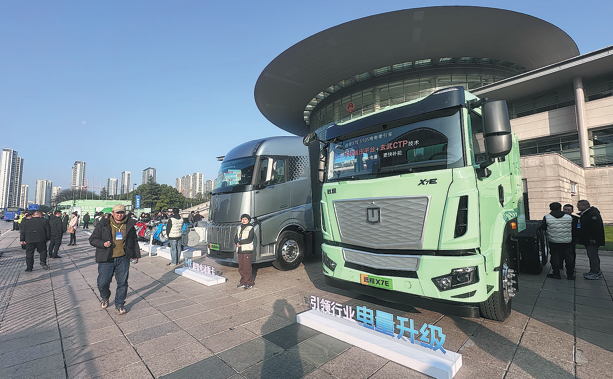
Methanol is emerging as a potential complement to battery electric and hydrogen technologies in China's push to decarbonize transport, particularly in regions and segments where infrastructure and cost constraints limit electrification.
Fan Xianjun, CEO of Farizon New Energy Commercial Vehicle Group, said methanol-hydrogen electric technology — a form of liquid new energy — is emerging as a practical pathway aligned with China's energy structure and security priorities.
Farizon's latest-generation methanol-hydrogen system, jointly developed with Bosch, has achieved a thermal efficiency of 50.3 percent, Fan said at a forum organized by China EV100, a Beijing-based industry think tank.
He said each liter of methanol can generate more than 2 kilowatt-hours of electricity, translating into an effective power cost of less than 1 yuan ($0.14) per kilowatt-hour.
When compared with diesel, fuel costs are 32 percent to 52 percent lower, offering both carbon reduction benefits and clear economic advantages that could accelerate the replacement of conventional fuels.
In the heavy-duty truck segment, Fan said methanol-hydrogen trucks show several advantages over battery electric models: purchase costs are about 10 percent lower, the driving range is much longer — at around 1,500 kilometers — and they can operate reliably in cold regions because methanol has a freezing point of minus 97.6 C.
Beyond vehicle performance, Fan highlighted infrastructure costs as a key advantage.
China's existing network of about 120,000 fuel stations can be retrofitted to handle methanol, with each storage tank requiring an investment of just 50,000 to 100,000 yuan, he said.
That compares with roughly 12 million yuan to build a hydrogen refueling station, about 8 million yuan for a battery swap station and around 1.5 million yuan for a fast-charging or ultra-fast charging site.
"Developing methanol energy and methanol-hydrogen electric vehicles is the lowest-cost path for China to advance its energy transition," Fan said.
Both national and local governments have introduced supportive policies, Fan said, but he added that gaps remain in areas such as refueling station standards, incentives for building such stations and methodologies for carbon footprint calculation and trading.
Industry participants broadly frame methanol as a complement to electrification rather than a competing route.
Fang Haifeng, chief expert at the China Automotive Technology and Research Center and deputy head of the China Automotive Strategy and Policy Research Center, said greater energy diversification and decarbonization are driving the auto sector toward a broader mix of clean energy pathways.
"Based on our industry research, we have analyzed the technical characteristics of methanol energy and methanol vehicles, as well as their carbon-reduction potential and economic performance," Fang said.
"We believe methanol can serve as one of the routes for the low-carbon transition of the automotive sector, particularly with significant application potential in commercial vehicles," he said.
Fang also called for policies to guide coal, chemical and related industries toward producing lower-carbon methanol by coupling green hydrogen and renewable electricity, while accelerating the substitution of green fuels in hard-to-electrify segments such as heavy-duty trucking and shipping.
Energy transitions tend to unfold gradually, with multiple technologies coexisting over extended periods, said Shao Yu, a senior research fellow at the National Institution for Finance and Development and adjunct EMBA professor at Fudan University.
Among current options, methanol stands out for its balance between cost and practicality, making ecosystem development a near-term priority, he said.
Zhu Liyang, president of the China Association of Circular Economy, said methanol produced from urban organic waste as well as captured carbon dioxide from power, steel and cement plants should be classified as clean or green methanol.
Such production routes turn waste into economic value while reducing environmental effect, he said.
lifusheng@chinadaily.com.cn











