International community should prevent revival of Japanese militarism









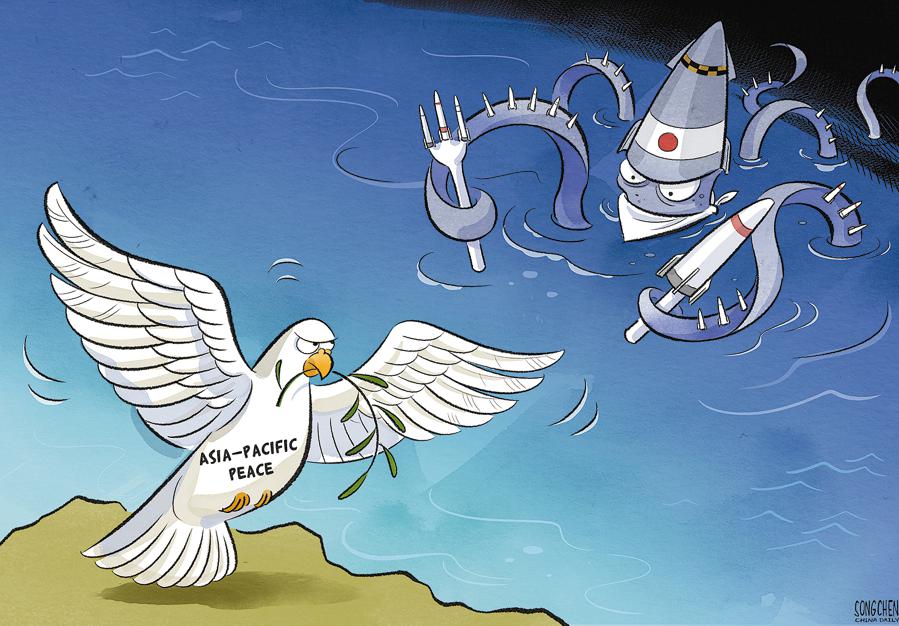
Recent remarks by some Japanese officials — who feel it is "not irresponsible" of Japan to consider nuclear weapons — and reports that Japan is not ruling out the procurement of nuclear submarines have once again triggered alarm in the region.
Equally troubling is Tokyo's decision to sharply increase the budget of its so-called "Official Security Assistance" program, under which it plans to provide defense equipment and supplies to the armed forces of Southeast Asian nations and other countries. These are not isolated developments, but part of a broader pattern in which Japan is steadily loosening long-standing restraints on its military posture.
A Chinese military spokesperson has rightly urged the international community to work together to prevent the revival of Japanese militarism.
The criticism over Japan's moves in military and security areas among the international community, including the Southeast Asian countries, has been vocal and consistent, Zhang Xiaogang, a spokesman for the Chinese Ministry of National Defense, said at a news conference on Thursday.
Some forces in Japan are fabricating excuses to accelerate the country's military buildup, have relaxed restrictions on arms exports, and even floated dangerous rhetoric about nuclear armament. Such actions expose the ulterior motives of right-wing elements in Japan who are determined to push the country down the path of remilitarization.
The nuclear issue is particularly sensitive. Any suggestion that Japan might acquire nuclear weapons or nuclear-powered strategic platforms strikes at the heart of the postwar international order and the global nuclear nonproliferation regime.
Foundational documents such as the Cairo Declaration, the Potsdam Proclamation and the Japanese Instrument of Surrender clearly stipulate that Japan must be completely disarmed and must not maintain industries or capabilities that would enable it to rearm for war. As a no-nuclear-weapon state party to the Treaty on the Non-Proliferation of Nuclear Weapons, Japan is obligated not to manufacture, acquire or possess nuclear weapons, and to accept strict international safeguards. These are nonnegotiable commitments under international law.
Domestically, Article 9 of Japan's own Constitution renounces war as a sovereign right and prohibits the threat or use of force, and for decades official interpretations barred the possession of offensive weapons and weapons of mass destruction. The Atomic Energy Basic Law of Japan confines nuclear activities to peaceful purposes only, explicitly excluding military use. The "Three Non-Nuclear Principles" — no possession, no manufacture and no introduction of nuclear weapons — further reinforce this stance.
Against this backdrop, questioning the taboo on nuclear weapons, discussions on revising key security documents, and hints about nuclear-powered submarines represent a dangerous erosion of postwar norms. History shows how right-wing forces in Japan have often portrayed it as "threatened" to justify expanding its military capabilities and loosening constitutional and legal constraints.
The expansion of arms exports and military assistance under various new labels also deserves scrutiny. Providing advanced military equipment to other countries while simultaneously accelerating one's own military buildup by increasing its military spending quickly to 2 percent of Japan's GDP in fiscal year 2025, two years ahead of schedule, risks fueling tensions and an arms race in the region.
The international community has established a clear framework to ensure Japan would never repeat its war history. All peace-loving nations should see through Tokyo's attempts to test the bottom line of international justice, uphold the postwar international order, and firmly oppose any moves toward nuclear armament or renewed militarism.