


Walking the paths of bravery and sacrifice
County blends red heritage, natural landscapes, storytelling, and modern tourism to revive memory, Yang Feiyue reports in Huichang, Jiangxi.









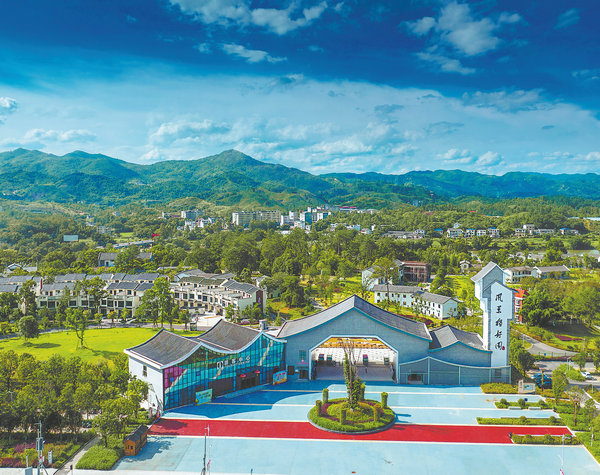
About a 40-minute drive north lies Fengjing Duhao Park, a sprawling cultural complex that blends historical memory with pastoral calm.
"This name is derived from Chairman Mao's poem Qing Ping Yue Huichang, written in Huichang during the summer of 1934," explains Zhang Yiqun, a staff member with the park's administration.
"It was his final poem composed in the Central Revolutionary Base, and the only one named after a county," she adds.
In the spring of 1934, the Red Army faced mounting pressure as the KMT forces tightened their encirclement of the Central Revolutionary Base. Huichang, on the southern front, was plunged into crisis after key positions fell.
Mao Zedong arrived to assess the situation, shifted the Red Army from static defense to flexible guerrilla tactics, and helped stabilize the front. As the southern line revived while other fronts faltered, Mao described it as fengjing duhao, meaning "the scenery here is uniquely fine".
Inspired by this moment, he climbed Huichang Mountain, which is a 10-minute drive away from Fengjing Duhao Park and wrote his final lyric before leaving the area.
Covering an area of 42 hectares, the park integrates six provincial-level cultural heritage sites, including Mao Zedong's former residence and the former headquarters of the Guangdong-Jiangxi provincial committee.
Traditional Hakka-style architecture has been carefully preserved through the restoration of facades and interior spaces of historic houses.
Eight exhibition halls built on historical architecture were dedicated to pivotal events and figures in China's revolutionary history, including the Nanchang Uprising, the Huichang campaign, the Red Army's influence in Huichang, as well as traces left by Mao Zedong and the reform and opening-up policy's chief architect Deng Xiaoping.
The exhibits utilize cutting-edge digital technologies that take one back to the tumultuous times with holograms, immersive experiences, and interactive visitor systems.
In front of Mao Zedong's former residence, Zhang pauses.
"From April to July 1934, Chairman Mao stayed here for more than three months. Despite being marginalized at the time, he never stopped paying attention to the revolutionary cause," she says.
Inside, the room is stark. A rusty kettle, a simple basin and wooden racks reflect the harsh living conditions of the time, underscoring the resolve behind historic decisions.