Immersion program sheds light on rural revitalization









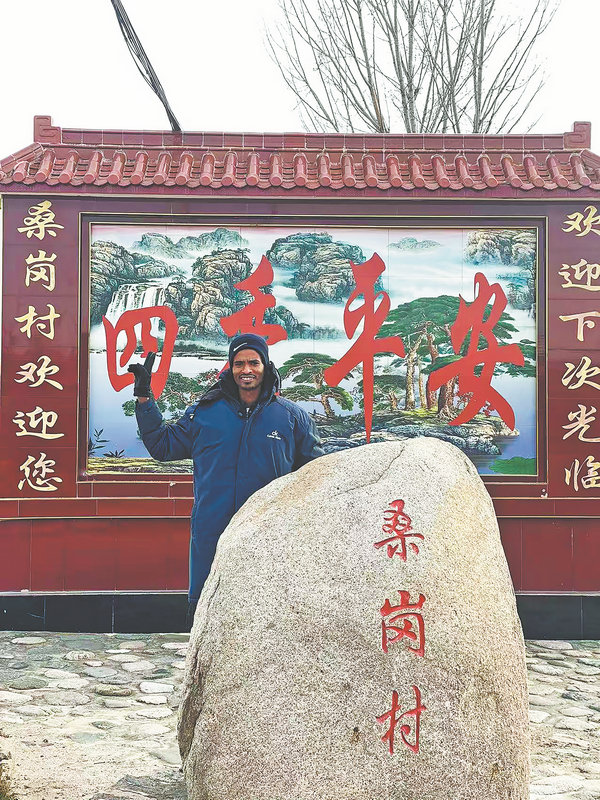
From Nov 29 to Dec 2, the College of Humanities and Development Studies at China Agricultural University (CAU) organized a field immersion program for 20 international students — from Latin America, Southeast Asia, and Africa, including myself — to visit Yixian county in Hebei province.
The trip offered a rare opportunity to observe agrarian transformation and social policy at the grassroots level in northern China.
One of the most memorable stops was Sanggang village, located about 60 kilometers from Yixian and 190 kilometers from Beijing. Home to 221 households and 652 residents, it reflects the classic agricultural lifestyle of the region: villagers produce traditional foods such as sweet potato noodles, flatbreads, marinated tofu, and persimmon cakes — items deeply rooted in local culture. And like many rural communities in China, Sanggang faces a steady outflow of working-age residents seeking better employment in Beijing, Tianjin, and other cities.
Sanggang's transformation began in 1996, when CAU scholars led by Professor Ye Jingzhong launched long-term cooperation with the local government. From 2000 to 2010, the team worked on village construction, infrastructure improvement, and rural capacity building.
What makes this partnership exceptional is its emphasis on participatory, community-driven development rather than the top-down interventions typical of conventional development models. Instead of treating villagers as passive recipients, the project involved them directly in decision-making, laying the foundation for a more empowered and cohesive rural society.
The second major phase (2010-2020) focused on smallholder-based poverty alleviation through the "nested market", an innovative system designed to rebuild trust between producers and consumers by removing middlemen and fostering direct connections. At Sanggang's village commodity collection center, each agricultural product is labeled with the producer's name. This simple but powerful measure ensures accountability and reinforces the identity and pride of smallholder farmers. If consumers encounter any problems, they can contact the producer directly using the information on the product tag.
Professor Ye once summarized the philosophy behind this approach: "Targeted poverty alleviation must step out of traditional stereotypes and pay attention to the features, potential, and agency of small farmers."
Another impressive achievement is Sanggang's terraced land rehabilitation project. Once-barren hillsides — formerly used only for gathering firewood — have been transformed into 153 mu (10.2 hectares) of productive farmland under collective village ownership.
The project was funded by a southern Chinese city through a national land policy that pairs urban expansion with rural farmland protection. It was my first time seeing such a mechanism in practice: when cities grow, they are required to support rural land restoration accordingly. The result is a win-win model that links urban development with rural revitalization.
Learning through service
One of the most inspiring aspects of the trip was meeting CAU postgraduate students stationed in Sanggang for long-term fieldwork. In addition to their academic research, they help manage the nested market, maintain collective assets, and support village governance.
"We come to the village to understand society through service and practice, and to reflect on what we learned in the classroom," said Ma Luyao, a PhD student based in the village.
Students who live and work alongside villagers gain insights no classroom can provide, allowing them to design solutions grounded in real-world needs. This model of immersive, hands-on education builds a deep understanding of rural realities — something I've found profoundly lacking in many developing countries, including my own, Ethiopia.
I have traveled through many rural areas in Ethiopia, yet I have rarely seen universities turn research into visible, lasting change. Too often, our studies end up as reports on shelves, disconnected from the lives they aim to improve. Sanggang, by contrast, shows that when universities, local governments, and villagers work hand in hand, they can build a model of rural development that is practical, sustainable, and truly rooted in community needs.
Walking through the village, I watched elderly farmers confidently managing high-value agricultural cooperatives, their sense of ownership reflected in every decision they made. I stood on hillsides once barren and eroded, now reshaped into fertile terraces. And I spoke with young graduate students who had become part of the village fabric, serving as researchers, organizers, and caretakers of collective assets. Their presence symbolized a rare kind of learning — one grounded in daily service, shared struggles, and genuine human connection.
Written by Lemi Chala Tamire, an Ethiopian PhD candidate in development studies at China Agricultural University. He is also a lecturer and researcher at Haramaya University, Ethiopia. He earned his master's degree in rural development and management studies at CAU from 2017 to 2019.
- Love sails through time: Launch of 'The Porcelain Maker's Daughter'
- Tom De Beuckelaer leads intl piano master class at Beijing Royal School
- Tianjin hosts Experience Tianjin international cultural exchange event
- Chongqing event highlights Kazantzakis' legacy in the country
- Listening before time runs out