



New oxidation process on the moon revealed
Study of Chang'e 6 samples shows lunar 'rust' originates from violent impacts









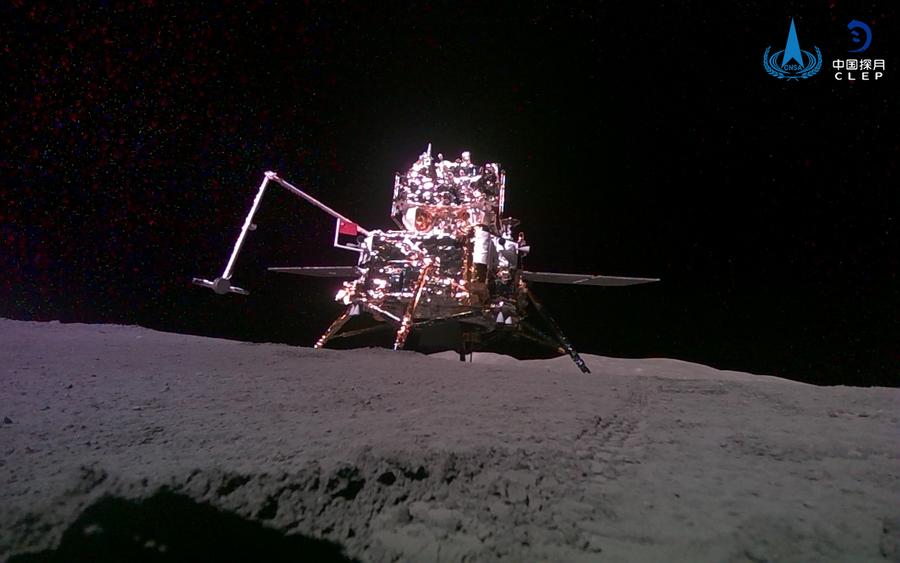
Chinese scientists have identified micrometer-sized crystals of hematite and maghemite in lunar soil for the first time, using samples brought back by the Chang'e 6 mission from the moon's far side.
The finding, published in the latest issue of Science Advances, reveals a previously unknown oxidation process on the moon. It provides direct sample-based evidence for the origin of magnetic anomalies around the South Pole-Aitken Basin and challenges the long-held view that the lunar surface is entirely in a reduced state with minimal oxidation, according to the China National Space Administration.
Researchers from Shandong University, the Institute of Geochemistry of the Chinese Academy of Sciences, and Yunnan University identified the iron oxides in Chang'e 6 samples collected from the South Pole-Aitken Basin, the largest and oldest known impact basin in the solar system.
The team used multiple analytical techniques, including micro-area electron microscopy, electron energy loss spectroscopy, and Raman spectroscopy. These methods confirmed the crystal structure and unique characteristics of the hematite particles and verified that they are native to the moon rather than contaminants from Earth.
Unlike on Earth, where rust forms through interactions between water and oxygen, the moon has long been considered a strongly reducing environment with minimal oxidation. Previous lunar samples lacked evidence of high-valent iron oxides such as hematite. The new study shows that lunar "rust" originates from violent impacts: when massive asteroids struck the moon, they generated transient, high-oxygen fugacity gas environments. In these extreme conditions, iron in troilite minerals was oxidized, releasing sulfur and forming hematite through vapor-phase deposition at temperatures ranging from 700 to 1,000 C.
A key byproduct of this process is magnetic minerals — magnetite and maghemite — which may serve as the mineral carriers for magnetic anomalies observed around the basin. The findings help address a long-standing mystery about the moon's magnetic features, as these intermediate products of impact-induced oxidation could have retained magnetic properties dating back to ancient impact events.
Researchers said the discovery enriches scientific understanding of the moon's evolutionary history and provides an important basis for future lunar studies.
The Chang'e 6 robotic mission — the world's first attempt to obtain samples from the moon's far side — was launched in May 2024 from the Wenchang Space Launch Center in Hainan province. The mission concluded after 53 days of maneuvers, retrieving 1,935.3 grams of material from the far side.
zhaolei@chinadaily.com.cn





