



Sino-German auto biz cooperation revved up
Expert: Both countries should enhance collaboration in technology, standards









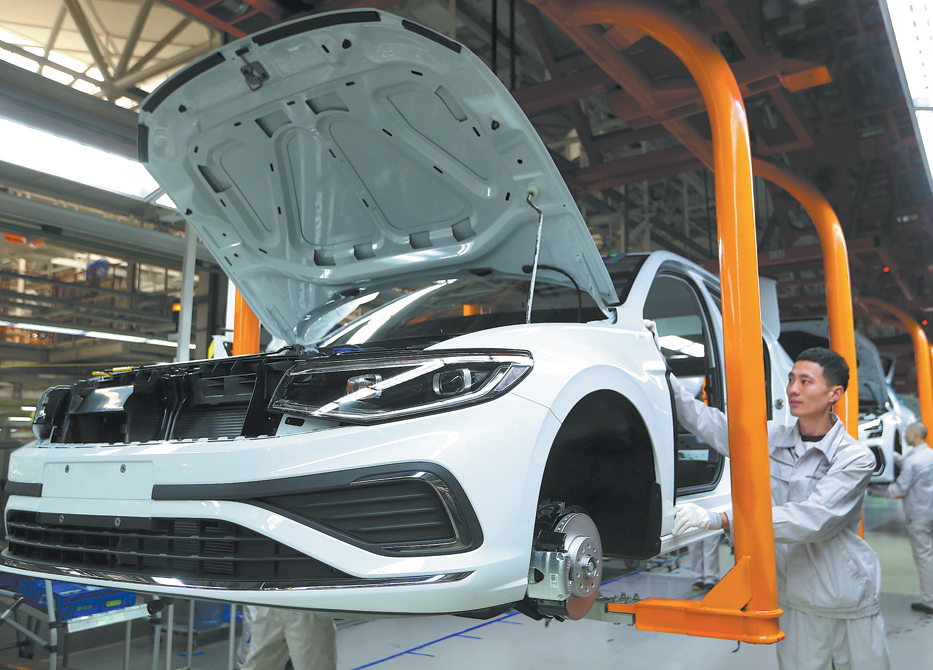
China and Germany are entering a new stage of collaboration in the automotive sector, moving beyond market complementarity to jointly develop technologies and standards that will help shape the global industry's transformation toward electrification and intelligence, experts and executives said.
They underscored the deepening ties between the two major automotive powers and called for joint efforts to build "a new ecosystem of global auto cooperation", at the just-concluded ninth Sino-German Automotive Conference in Changchun, Jilin province.
"Over the past decades, China-Germany cooperation in the auto sector has demonstrated strong resilience and mutual benefit," said Chen Jian, former vice-minister of the Ministry of Commerce. "As the industry enters a new stage defined by electrification and digitalization, both sides should further enhance collaboration in technology, standards and industrial chains to build a more open and symbiotic ecosystem."
Industry experts said the foundation for cooperation is shifting from traditional trade and investment to innovation-driven partnerships. Ron Zheng, a senior partner and Asia head of automotive practice at Roland Berger, said that the logic of cooperation between China and Germany is evolving as China takes a more proactive role in global industrial restructuring.
"Chinese players are becoming increasingly active in developing electric and intelligent vehicles. This is reshaping the pattern of international cooperation and providing new opportunities for both sides. China's supply chain in this field is now complete and deep, allowing it to support and empower its partners in return," Zheng said, citing Volkswagen's cooperation with Xpeng as an example.
Jochem Heizmann, former member of the Volkswagen Group board of management and former CEO of Volkswagen Group China, said the country's rapid innovation has injected new vitality into global competition.
"China's speed of innovation is impressive. Both sides can learn from each other — Germany can learn from China's speed and digital innovation, while China can still draw from Germany's experience in engineering and industrial precision."
He also identified plug-in hybrids built on dedicated EV platforms as a promising technology, adding that combining German quality with Chinese speed will provide a strong competitive edge globally.
China's auto sector has maintained solid growth. According to the China Association of Automobile Manufacturers, the country produced 27.69 million vehicles from January to October, up more than 10 percent year-on-year, while new energy vehicle output hit 13.01 million in the first 10 months, up 33.1 percent. In October, NEV sales accounted for 51.6 percent of total new car sales, the first time that their monthly share exceeded 50 percent. China's NEV exports also surged, reaching 2.01 million units in the first 10 months, up 90.4 percent year-on-year.
Executives from major Chinese automakers said cooperation with German partners will continue to expand into new energy, smart connectivity and supply-chain resilience. The partnership has already yielded tangible results. In Changchun, Audi FAW New Energy Vehicle Co Ltd — a joint venture between Audi and China FAW group — has built Audi's first all-electric vehicle plant in China and delivered the Audi Q6L e-tron electric SUV in July.
"We aim to jointly promote the sustainable development of the global automotive industry," said Liu Yigong, president of China FAW group, one of China's leading automakers.
Analysts said the push for deeper cooperation comes as both countries accelerate their green and digital transitions. For Germany, collaboration with China offers access to a vast and fast-growing NEV market as well as local innovation in batteries and smart technologies. For China, German expertise in engineering and brand-building continues to provide valuable experience for global expansion.
"The next phase of cooperation will be characterized by joint research and development, shared platforms and co-created standards," said Zheng from Roland Berger. "This will not only help both countries maintain competitiveness, but also drive the sustainable transformation of the global auto industry."
Addressing emerging challenges such as rising tariffs, Zheng urged deeper engagement between companies and their respective governments. "Automotive development today can't rely on a single country's supply chain," he said. "Stronger integration and communication will help both sides improve efficiency and reduce risks."
Zheng added that the decades of Sino-German cooperation offer lessons for others. "When both sides share long-term goals and contribute equally, collaboration can bring benefits in technology, industry and market development."
lijing2009@chinadaily.com.cn
- Paint and coating industry's global leader eyes China's industrial upgrading
- Summit offers Africa chance to redefine role
- Auto market rides high on NEV sales growth
- Former Volkswagen exec praises China's auto innovation and speed
- China's major smart agricultural drone maker unveils next-gen products




















