


Confucianism maintains bridge between two cultures










Philosopher's teachings stand as a testament to the enduring intellectual and artistic affinity, creating a bond for China and South Korea, Zhao Xu reports.
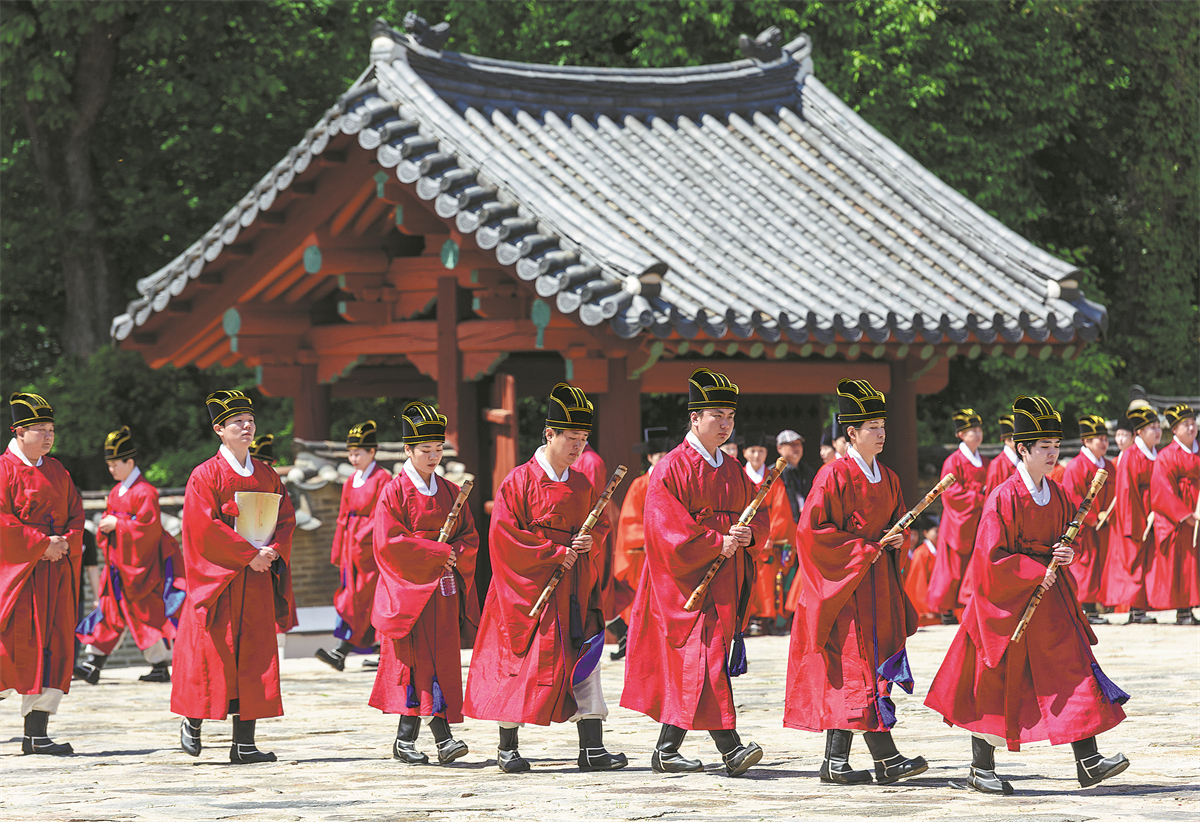
'The autumn wind sighs soft and thin, no kindred soul to share within. Rain taps the pane in midnight's hue, my heart drifts far — where dreams are true."
Sometime in the latter half of the ninth century, Korean poet Choe Chi-won (known in China as Cui Zhiyuan, 857 to early 10th century) composed these lines in classical Chinese during his long sojourn in China's Tang Dynasty (618-907).
Belonging to the late Unified Silla period (668-935), Choe is revered as one of the founding figures of the Korean Peninsula's Confucian scholarly tradition, which would later blossom in the Goryeo (918-1392) and Joseon (1392-1910) dynasties.
He came to embody the ideal of a Confucian intellectual — a figure of integrity, learning and patriotic devotion — with his "drifting heart" perhaps reaching toward his homeland more than 1,000 kilometers away.
The poem was composed while Choe served as a county commandant in Lishui, part of today's Nanjing, in eastern China's Jiangsu province. He spent many years studying in China and, through rigorous examination, attained the jinshi degree — the highest level of the Tang imperial civil service exams — qualifying him to take up an official post and marking his mastery of classical learning.
In 958, just a few decades after Choe's death, the Goryeo Dynasty introduced the Gwageo system, modeled after China's imperial examinations, which were established during the Sui Dynasty (581-618). Similar to its Chinese counterpart, it aimed to select officials based on merit rather than birth, helping the Goryeo consolidate control over the peninsula.
After returning from China in 884, Choe sought to revive the declining Silla kingdom through Confucian principles by advocating for the strengthening of the monarchy, the curtailment of aristocratic abuses, and merit-based appointments to address corruption, improve military organization, and enhance civil governance.
Although his reforms largely went unheeded, Choe's efforts and writings left a lasting legacy, shaping the intellectual and moral foundations of later Confucian bureaucracy on the Korean Peninsula, including that of Goryeo, which ultimately ended Silla's rule in 935.





