



Educational exchanges sow seeds of understanding









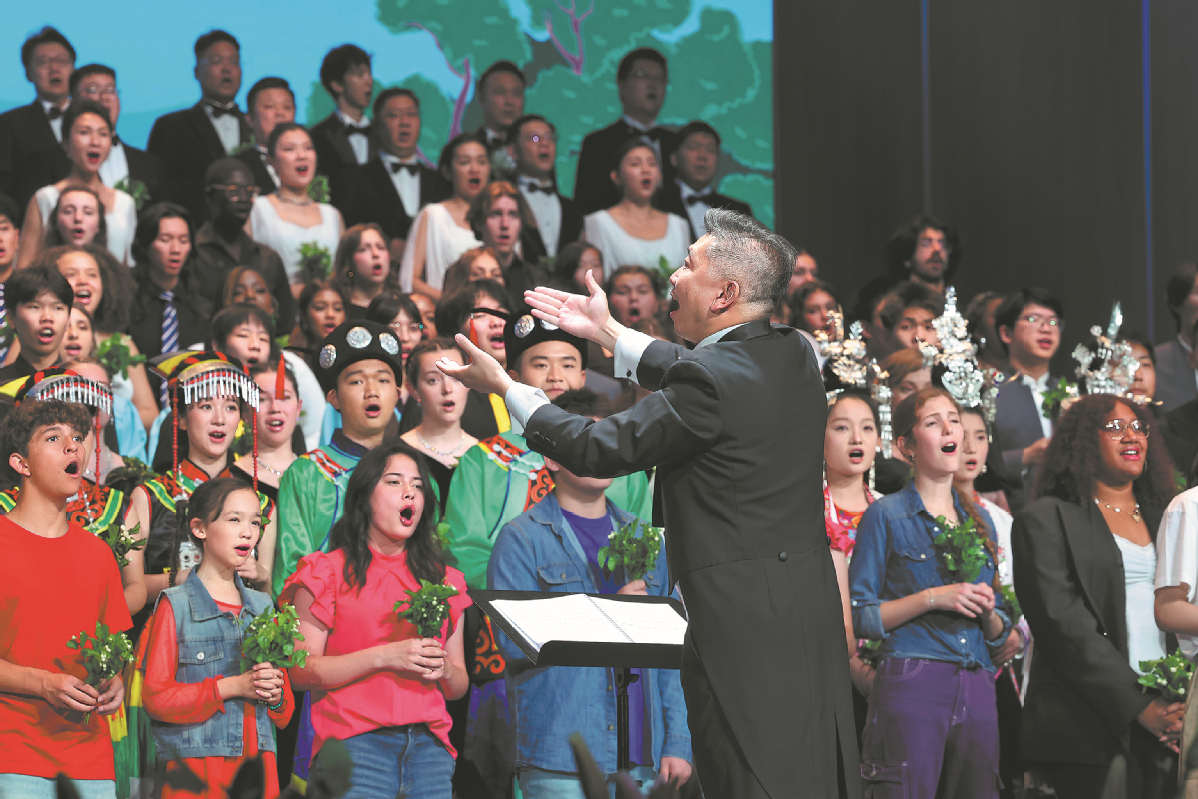
For James Long, co-chair of the Durham Sister Cities Kunshan Committee, his connection with China began in the classroom.
"I minored in Chinese studies as an undergraduate," Long recalled. "I learned at the Confucius Institute and still have many trinkets from my time there. I remember it fondly."
That experience led him to a studyabroad program, in which he immersed himself in Chinese language studies at Nanjing Normal University in Nanjing, the capital of East China's Jiangsu province. Having been educated in both the United States and China, Long believes that such exchanges are the cornerstone of strong bilateral ties.
"Our countries are economically married, but also from a philosophical standpoint, we have to learn from each other," he said. Seeing the country firsthand will allow people in the US, who might have little understanding of China, to understand the speed of China's development and its rising standard of living, he added.
Long is now channeling that conviction into action by working to establish student exchange programs between his home state of North Carolina — where Durham, a city of around 280,000 residents, is located — and China. He acknowledged that the language barrier can be intimidating, as both Chinese and English can be difficult to learn, but he sees technology as a powerful bridge.
"I think the internet is helping change that. People are becoming very interested in China because they can see videos (of Chinese cities). It's mind-blowing to see how advanced these cities are."
He said that digital platforms have sparked curiosity among young people in the US. "A lot of Americans are now starting to learn Chinese just on their phones. There are short videos on TikTok teaching people Chinese, and it's popular."
Long expressed the belief that educational exchange, as an important aspect of people-to-people exchanges, plays a vital role in promoting mutual understanding.
That view was echoed by several representatives from the US education, political and academic sectors, who gathered for a recent panel discussion on bilateral educational exchange in Hangzhou, the capital of East China's Zhejiang province.
They agreed that such cooperation is not merely about transferring knowledge, but also about fostering dialogue and nurturing friendship.
Susan Thornton, vice-chair of the US Heartland China Association, said that the future of US-China relations depends not only on governments and businesses, but also on everyday citizens.
In recent decades, millions of Chinese students have studied in the US. However, participants in the discussion noted that far fewer US students are now studying in China, and Chinese students studying in the US also face increasing obstacles.
"If we are to sustain the foundation of trust and cooperation between our people, that has to change," Thornton said.
Earlier this year, the US Heartland China Association brought a group of 20 young agricultural professionals and students from the US heartland to Beijing and Central China's Henan province.
They visited farms, universities and agri-tech companies, met with Chinese peers and business leaders and saw firsthand how Chinese farmers are confronting many of the same challenges that they face at home.
Thornton added that many members of the group, who had never left the US before, returned home with broadened perspectives and a renewed sense of common purpose.
She called for more efforts and support from universities, foundations, nongovernmental organizations and corporations to make studying in China more accessible for US students from all backgrounds.
"If we can inspire more American students to study in China and continue to welcome Chinese students in the US, then the future of US-China relations will rest on a stronger and more resilient foundation," she said.
Natalie Mihalek, a member of the Pennsylvania House of Representatives, shared similar views. Educational exchanges, she said, "remind us that while our cultures and systems may differ, our aspirations for knowledge, opportunity and peace are remarkably the same".
"When students and teachers from different countries share classrooms, ideas and experiences, they are not just studying math or science. They are learning empathy, communication and understanding. They are building bridges of trust that politics cannot," Mihalek said.
She added that she looks forward to strengthening the ties between the educational systems of the two countries, including expanding student exchange opportunities, increasing teacher-to-teacher collaboration and investing in joint research initiatives.
Chen Ye and Qi Xiao in Hangzhou contributed to this story.
Contact the writers at zhoujin@chinadaily.com.cn


- Tianjin town plays leading role in global instrument trade
- AI tool maps Chinese family trees, links mainland and Taiwan heritage
- Shanghai to stage new production of Natasha, Pierre and the Great Comet of 1812
- First merchandise store for 33rd FISU Winter World University Games opens in Beijing
- China urges vigilance over Japan's military and security moves
- China launches major research project on high-altitude health risks





