



China mourns Murayama whose statement lives on









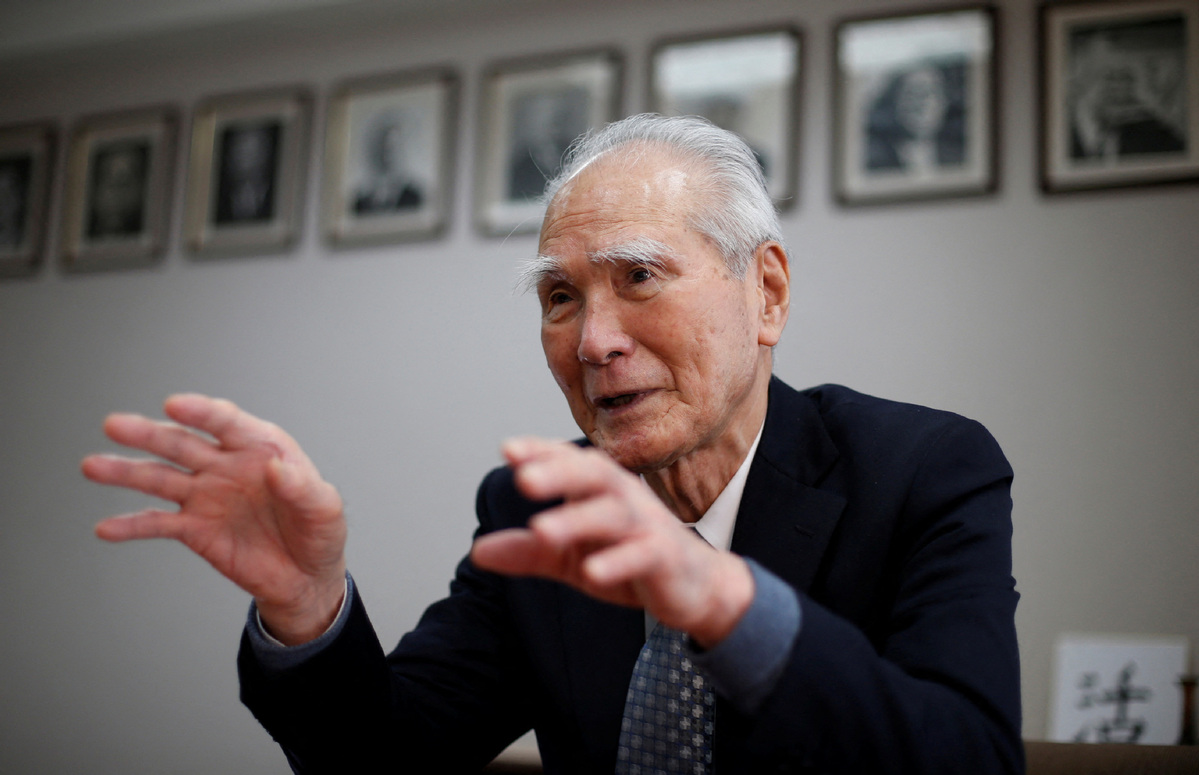
China has expressed deep condolences over the passing of former Japanese prime minister Tomiichi Murayama, the first Japanese leader who officially apologized for the country's World War II atrocities, gained trust for Japan and won worldwide acknowledgment.
The 81st prime minister of Japan, also the first from the Japan Socialist Party, died on Friday morning in his hometown city of Oita at 101. Foreign Ministry spokesman Lin Jian also extended sincere sympathy to his family, citing Murayama as a statesman with a sense of justice and a long-standing friend of the Chinese people.
Officials and experts emphasized that inheriting and advancing the Murayama Statement, which explicitly acknowledged Japan's colonial rule and aggression in Asia, is especially important in today's increasingly right-leaning Japan.
Born on March 3, 1924, in Oita Prefecture, Murayama became chairman of the Japan Socialist Party in 1993, and served as prime minister from June 1994 through January 1996.
On Aug 15, 1995, Murayama issued the historic cabinet-endorsed statement. The Murayama Statement declared that "Japan, following a mistaken national policy, advanced along the road to war, only to ensnare the Japanese people in a fateful crisis, and, through its colonial rule and aggression, caused tremendous damage and suffering to the people of many countries, particularly to those of Asian nations." The statement specifically expressed "deep remorse and heartfelt apology".
Lin said the Murayama Statement represents a solemn declaration and commitment by the Japanese government to the people of victim countries in Asia and the international community, which needs to be honored with good faith.
He added he hoped that Tokyo will work with Beijing in the same direction to build a constructive and stable bilateral relationship that meets the demands of the new era.
Takakage Fujita, secretary-general of the Association for Inheriting and Propagating the Murayama Statement, told China Daily that the statement, which acknowledges Japan's colonial and aggressive history, holds significant importance.
He said that Murayama's legacy will continue to be upheld, and efforts would be made to further promote the statement throughout Japan.
Fujita said that he often spoke with Murayama, who was concerned that young Japanese people study history too little and emphasized that schools should teach modern history seriously, especially Japan's invasion of China and colonization of the Korean Peninsula.
Mizuho Fukushima, head of the Social Democratic Party, wrote on social media that Murayama was her "political father" and that his statement had been "of great political significance". "I feel truly saddened."
Murayama had been scheduled to deliver a written address next Tuesday at a symposium titled "Safeguarding Peace and Building the Future Together", commemorating the 80th anniversary of the victory in the Chinese People's War of Resistance Against Japanese Aggression (1931-45) and the World Anti-Fascist War.
Zhou Yongsheng, a professor at the Institute of International Relations at China Foreign Affairs University in Beijing, said that when Murayama became Japan's prime minister as head of the Japan Socialist Party, he did bring changes to the political landscape.
"Murayama served as a voice for peace, acting as a crucial bulwark against the drift toward remilitarization. Now, as Japan's politics continue to shift to the right, Japanese politicians need to revisit Murayama's legacy, to face history squarely and hold fast to the principles of peace," Zhou said.
The Chinese Foreign Ministry urged Japan to face up to and reflect on the history of aggression, act prudently on historical issues such as the issue of the Yasukuni Shrine and make a clean break with militarism.
Lin, the ministry's spokesman, made the remarks after outgoing Japanese Prime Minister Shigeru Ishiba and head of Japan's ruling Liberal Democratic Party Sanae Takaichi sent ritual offerings to the shrine on Friday, which honors 14 convicted Class-A Japanese war criminals from World War II.
Contact the writers at houjunjie@chinadaily.com.cn


- Report blames management for deadly Yunnan tunnel flood
- Companies flock to Shanghai home appliances expo
- Three people perish in Guangdong house fire
- Experts: too early to tell if super El Nino will hit this year
- China recovers $4.95b in medical insurance funds in 2025
- China launches remote sensing satellite





