



Taiwan's return to China a vital part of post-World War II order









Editor's note: On Oct 15, a seminar marking the 80th anniversary of Taiwan's restoration to China was held at Beijing Union University. Experts reviewed historical documents, reaffirmed the legal basis of Taiwan's return to the motherland, and rebutted the so-called "undetermined status of Taiwan" narrative. Excerpts follow:
UN resolution requires following one-China principle
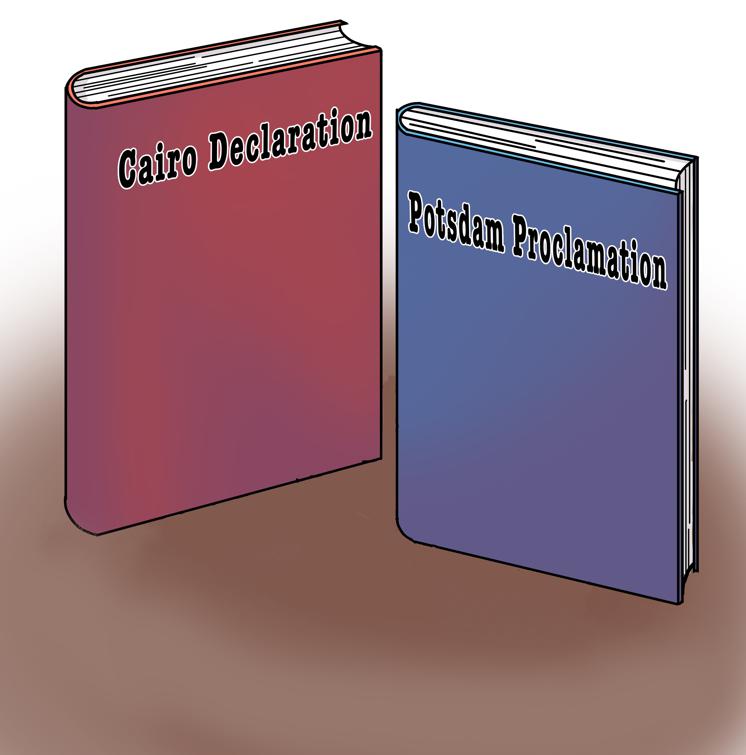
Taiwan's restoration to China was the outcome of the victory in the Chinese People's War of Resistance Against Japanese Aggression (1931-45) and the World Anti-Fascist War. Following their summit in Cairo, Egypt, on Dec 1, 1943, China, the United States and the United Kingdom issued the Cairo Declaration, which unequivocally stated that the three Allied powers will ensure all the Chinese territories captured and occupied by Japan, including Northeast China, Taiwan and Penghu Islands, are restored to China. As a pivotal document in international law, the Cairo Declaration laid the groundwork for the establishment of the postwar world order, especially in the Asia-Pacific region.
On July 26, 1945, the same three countries issued the Potsdam Proclamation, stipulating the terms of Japan's surrender. Article 8 of the proclamation says "the terms of the Cairo Declaration shall be carried out and Japanese sovereignty shall be limited to the islands of Honshu, Hokkaido, Kyushu, Shikoku and such minor islands as we determine".
As an instrument of Japan's surrender, the Potsdam Proclamation has legally binding force in international law. On Aug 14,1945, Japan officially accepted the Potsdam Proclamation. The next month, during the formal Japanese surrender ceremony aboard USS Missouri, the Japanese government's representative signed the Instrument of Surrender while committing to carry out the provisions of the Potsdam Proclamation "in good faith".
Thus a legally interlocking chain was formed by the Cairo Declaration, the Potsdam Proclamation and the Japanese Instrument of Surrender, affirming that Japan must restore all Chinese territories including Taiwan to China. On Oct 25, 1945, the ceremony to accept Japan's surrender in the Taiwan province of the China war theater was held in Taipei, where Ando Rikichi, the Japanese government head on the island, signed the formal surrender document.
The Chinese government announced that Taiwan and the Penghu Islands had been restored to China, and it was resuming the exercise of sovereignty over Taiwan. From that point on, China recovered Taiwan de jure and de facto. And its subsequent administration and governance have been widely accepted and recognized by the international community, constituting an integral part of the international order based on international law.
The Democratic Progressive Party authorities' attempt to use the so-called "San Francisco Peace Treaty" to claim that the two sides of the Taiwan Strait "should not be subordinate to each other" is doomed to failure. The "peace treaty" is a product of a separate treaty between Japan and the US and its allies, which excluded most of the countries that resisted Japanese aggression, particularly China and the Soviet Union. The "peace treaty" violates a series of important international documents issued during and after World War II, making it illegal and invalid.
The island of Taiwan, as part of China, was not, is not and will not be entitled to keep any "diplomatic" relations with other countries. After the PRC was founded in 1949, the central government of the PRC rightfully became the sole legal government of China. China's sovereignty remains indivisible, and Taiwan's status as part of China's territory remains unchanged, both politically and legally. The government of the PRC naturally represents the whole China and fully enjoys and exercises China's sovereignty.
In 1971, the United Nations General Assembly adopted Resolution 2758 with an overwhelming majority. The resolution says the consensus is "to restore all its rights to the People's Republic of China and to recognize the representatives of its Government as the only legitimate representatives of China to the United Nations". Hence, upholding and respecting the authority of the UN requires adherence to the one-China principle.
Wang Shushen is deputy director of the Institute of Taiwan Studies, Chinese Academy of Social Sciences.





