'US menu' exposes its hegemonic foreign policy










The United States tends to practice the law of the jungle in international relations on the pretext of promoting "democracy" or protecting "human rights". In early 2024, then US Secretary of State Antony Blinken said at the Munich Security Conference that "If you're not at the table in the international system, you're going to be on the menu."
We have studied the issue carefully and tried to figure out the "menu" according to the US' priorities.
Surprisingly, the American people top the list. For more than 200 years since the founding of the country, US rulers/politicians have prioritized exploiting the American people. Despite their lofty rhetoric about "democracy", "human rights" and "freedom", the lives of ordinary Americans have not seen any substantial improvement in the past decades.
As a matter of fact, US Vice-President JD Vance's memoir, Hillbilly Elegy, vividly depicts the miserable living conditions of the US working class today.
The wealth gap in the US continues to widen — the top 1 percent of super-rich now control around 30 percent of the country's wealth, while the bottom 50 percent hold merely 2.5 percent. Worse, about 40 million people in the US live below the poverty line. And despite more than 200 years of "democratic" elections, the condition of low-income individuals, who constitute the vast majority of the US population, has deteriorated, exposing the hypocrisy of US democracy.
Second on the "menu" are US allies, friends and loyal followers. As former US secretary of state Henry Kissinger once said, "To be an enemy of America can be dangerous, but to be a friend is fatal."
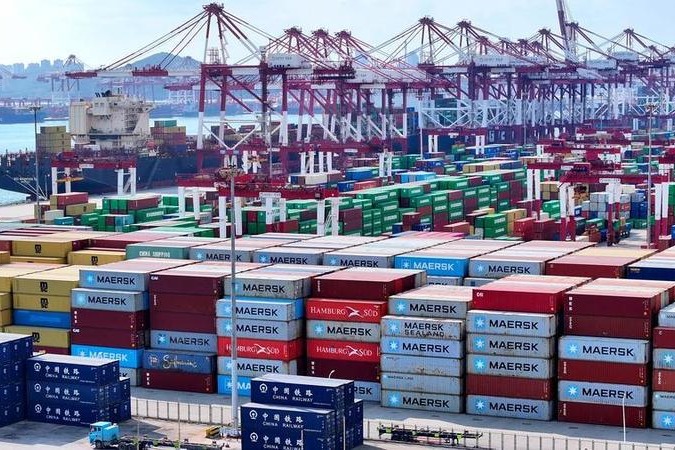
The US always seeks to fulfill its own interests at the expense of others. For instance, it has long suppressed the Japanese yen and Japan's foreign trade, gaining control over Japan's economic and financial lifelines through the Plaza Accord. And it has sown divisions within the European Union, undermined the euro's status, and pressured EU member states to invest more in the US. It has even imposed excessive tariffs on imports from its trade partners, without exempting its close allies.
On the geopolitical front, the US treats its allies as instruments to advance its strategic objectives, often forcing them into endless, lose-lose proxy wars and unnecessary conflicts. In terms of foreign policy, it demands all allies to act in unison, frequently meddles in their internal affairs, and strips them of their independence.
Third on the "menu" are the Global South countries. Apart from reaping huge profits from the two world wars, the US also profited from the numerous regional conflicts and "color revolutions" it has triggered to maintain its economic and strategic dominance.
Fourth on the "menu" are US "adversaries". However, Washington has recently adopted a more indirect approach toward its "adversaries". The wars in Afghanistan and Iraq, which dragged on for two decades, cost trillions of dollars and the lives of more than 7,000 US soldiers, serving as a stark reminder of the costly consequences of direct confrontation.
So Washington now avoids directly confronting its "adversaries", particularly those armed with nuclear weapons.
But what about Russia? Using different strategies, the US continues to reap the dividends of the disintegration of the Soviet Union. And despite Russia adopting a Western political system, the US still views it as a major threat.
While Washington and Moscow have never engaged in direct warfare, they have clashed over issues such as NATO's eastward expansion and missile defense system. Washington consistently seeks to chip away at Moscow's interests. But since Moscow's nuclear weapons arsenal is on par with, if not larger than, that of Washington, the US is unlikely to risk a strategic confrontation with Russia until it is utterly weakened.
As for China, it has become the toughest challenges for the US because it strongly opposes Washington's unfair, self-serving trade and foreign policy.
The US wishes to once again place China on its menu, but it knows that the cost of confronting the world's second-largest economy and a major technological and military power is too high.
Moreover, once the US realizes an adversary is undefeatable, it often opts for negotiations. This is exactly how the United Kingdom behaved in the 1980s — after realizing it could not prevail over China militarily, it eventually negotiated with Beijing to resolve the issue of Hong Kong's return to the motherland.
Since China is determined to safeguard its sovereignty and territorial integrity, the US knows any attempt to assert its hegemony is doomed to failure. In the face of US hegemonism, the Chinese people remain firm and united.
Being committed to improving the well-being of all humanity, China has rejected the Western logic that "power inevitably leads to hegemony". In fact, it has been making sincere efforts to build a just and equitable global governance system, and pursue mutual benefit.
More importantly, the rejuvenation of the Chinese nation is not merely a right of the Chinese people but also the fulfillment of their obligation and responsibility toward humanity.
The author is a university professor in Beijing.
The views don't necessarily reflect those of China Daily.
If you have a specific expertise, or would like to share your thought about our stories, then send us your writings at opinion@chinadaily.com.cn, and comment@chinadaily.com.cn.