


Dance's dramatic steps breathe life into palace's relics









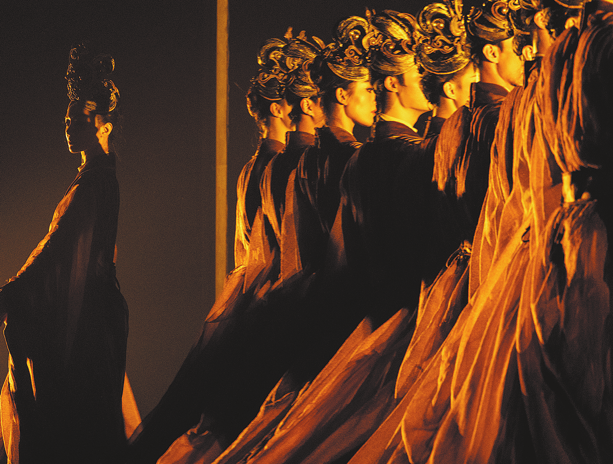 Scenes from the latest dance drama The Palace Through Time. The drama, inspired by the Yongle Palace, premiered in Beijing on Oct 3. CHINA DAILY
One such sequence is a group dance inspired by the caisson ceiling, a decorative architectural feature in traditional Chinese buildings. Dancers, adorned in exquisite costumes, rise, overlap their arms, and spin in rhythmic patterns, evoking the layered radiance that extends from the ceiling's center. Above them, shifting lights respond to their movements, as if the millennia-old dougong (bracket sets) were reconstructed on the stage.
"The choreography not only conveys the grandeur of ancient architecture but also subtly reflects the Eastern philosophy of 'the round heaven and the square earth'," the director elaborates.
In another striking portrayal, dancer Zhang Han embodies a blueglazed jiao shen (corner god), a 700-year-old guardian deity. In traditional Chinese architecture, jiao shen is a decorative component symbolizing strength, stability, and balance.
"The role carries symbolic nobility as a protector, yet it is also a touch of glory, eternally fixed in place," Zhang notes. "It represents the endurance of craftsmanship and the silent dignity of objects made by human hands. By bringing it to life, we reveal the humanity embedded in the relics."
The stage design complements these themes with subtlety and imagination. Instead of realistic ancient architectural sets, the production uses a rotating open stage that provides ample space for artistic interpretation.
Lighting and projections simulate the contours of Yongle Palace's halls and the vivid colors of its murals. When the narrative shifts, subtle changes in lighting tones seamlessly transition the audience from ancient to contemporary settings.
Co-director and co-choreographer Xie Changhui recalls that the team's research extended beyond observation, speaking with people who witnessed the palace's relocation in the 1950s.
"We learned about the artisans who restored these treasures and the young builders involved in the relocation project, many under the age of 30 at the time," she says. "Their dedication is woven into every movement and design, infusing the dance with emotion that deeply resonates.
"The dance drama is not just a portrayal of history," Xie adds. "It is also an emotional narrative — a celebration of youth, passion, and the vital role of human dedication in preserving and reinterpreting culture."