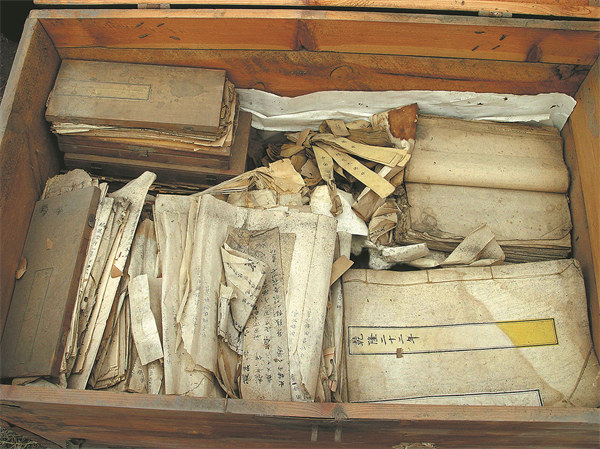
Some storerooms were actually in dangerous disrepair, with fragile staircases, and some artifacts were stored in cramped, unlit spaces. Others were placed on top of tall cabinets, altars, or inside towers. Handling fragile treasures in such precarious settings demanded not only patience but also courage as a single misstep could mean falling from dark staircases, altar tops, or makeshift scaffolding.
"Although danger constantly lurked around us, it didn't scare us. Instead, it trained us and strengthened our resolve," says Wang.
For seven years, Wang and his colleagues moved ceaselessly through storerooms of all sizes, weaving among artifacts piled high and hidden in shadows.
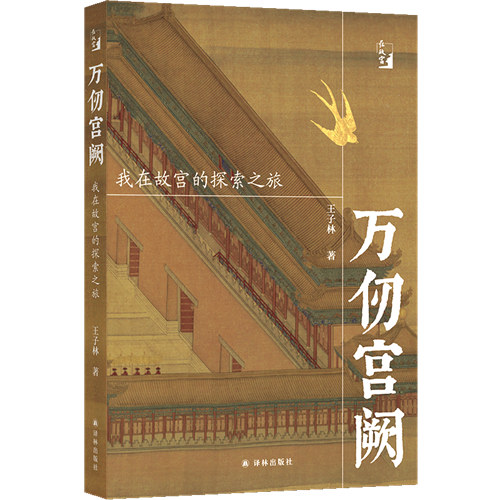
In his new book Wanren Gongque: Wo Zai Gugong De Tansuo Zhilyu (literally, Towering-walled Palace: My Exploration Journey in the Forbidden City), which Yilin Press has recently published, Wang meticulously recounts these experiences. With warmth and detail, he describes the daily work of the Palace Museum employees: cataloging relics, safeguarding storerooms and planning exhibitions.
The book weaves personal experiences with academic reflections, using a warm and delicate narrative to portray the author's nearly 40-year journey working at the Palace Museum.
Through a deep analysis of the architecture, collections and historical culture of the Palace Museum, the book explores the intertwining of tradition and modernity, contemplating how to innovate while preserving cultural roots.
"With over 30 years of dedicated research into the original state of the palaces, the author's unique experiences infuse academic investigation with warmth, reflecting his deep reverence and passion for cultural heritage," says Wang Lei, the book's editor.
"From his firsthand perspective, Wang Zilin guides readers into the Forbidden City's most secret corners — the unrestored palaces that remain largely untouched since imperial times. Amid the weathered palace walls and dust-covered artifacts, he unveils the cultural codes of the Yuan (1271-1368), Ming, and Qing dynasties' orthodox heritage," the editor says.
When connecting one palace to another, Wang Zilin finds that a field of ancient culture emerges.
"The Zhou Li (Rites of Zhou), Li Ji (Book of Rites), Shi Jing (Book of Songs), and Shang Shu (Book of Documents) are its original narrative codes, the foundational principles. These are the codes hidden within the original palaces and the light within ancient culture," the writer says.
But he also warns that many original palace spaces have "disappeared "over time through renovations.

According to Wang Zilin's rough estimate, only two truly original spaces are left: the Xuanji Hall Complex and the Yanqing Hall-Huifeng Pavilion area. The ground remains as it was in the past, the buildings are the same as before, and the flowers, grass and trees are also from the past. Even the piece of wall plaster that is about to fall off is from the past.
"Can we preserve these two original spaces?" Wang Zilin asks.
Unlike other museums, the Forbidden City is not only a repository for collection, preservation, display, research and education, but it also has an emotional and nostalgic role because it is a World Heritage site, Wang Zilin writes.
He draws comparisons to the Parthenon atop the Acropolis in Athens. Despite its broken columns and scattered remnants, the ruined temple retains its grandeur. Its very imperfections testify to history and endurance.
"So, must a weathered door be replaced with a new one? Must a crumbling wall be torn down and rebuilt as a new wall? Should a seemingly peeling column be removed and replaced with a new wooden one? These are questions worth pondering," he writes, advocating instead for the philosophy of "restoring the old as old".
This concept has also influenced subsequent preservation practices at the Forbidden City.
"In recent years, we have gradually recognized the importance of 'restoring the old as old'. For example, we reglaze and refire removed glazed tiles, preserve some paintings in their original state without repainting, and retain original materials whenever replacement is not absolutely necessary. We oppose turning the Forbidden City into a park or garden; as a World Heritage site, its architecture and environment must remain tied to the past," Wang Zilin says.