


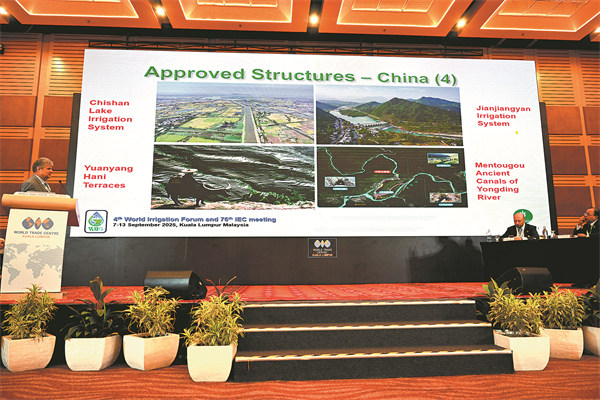
The Yuanyang Hani Terraces in Southwest China's Yunnan province, a World Cultural Heritage site and Globally Important Agricultural Heritage System, were further honored when they were added to the 2025 World Heritage Irrigation Structures list on Sept 10.
This mountain farming irrigation system, which has been used for over 1,300 years, is now one of the few agricultural civilizations worldwide to achieve all three heritage titles. The system vividly demonstrates the Chinese nation's ecological wisdom of "harmonious coexistence between humans and nature".
The Yuanyang Hani Terraces are nestled in the Ailao Mountains along the southern bank of the Red River in Yunnan. This remarkable irrigation system spans 3,740 hectares and comprises three main zones. According to research, the terraces were built as early as the Tang Dynasty (618-907). The local Hani ethnic group carved the terraces along the mountain slopes, passing down their agricultural practices through generations. Today, 305 canals crisscross the area, resembling blood vessels that nourish the vast terraced fields.
These terraces are not isolated, but integrate seamlessly with the surrounding forests, water systems and villages, creating a harmonious ecosystem. Li Jin, head of the water resources and hydropower survey and the design team in Yuanyang county, notes that the forests on the mountaintops conserve water sources, while canals channel water through the villages to irrigate the terraces.
Locals regard the mountain forests as "sacred", where trees are banned from being cut down on a whim. Ma Youde, a villager, says: "If anyone needs timber to build a house, it must be approved by the entire village. After a tree is cut down, it must promptly be replaced."
In recent years, the ecological and cultural value of the Hani Terraces has gained global recognition. The local government has implemented multiple measures, including village planning, ecological compensation and comprehensive monitoring systems, to enhance the protection and sustainable utilization of this heritage.
For example, the upcoming water system connectivity project will blend traditional irrigation wisdom with modern water technologies, revitalizing local agriculture, conserving ecosystems and improving people's livelihoods.
The Yuanyang Hani Terraces represent both an agricultural marvel and a cultural legacy.
For centuries, people of the Hani ethnic group have nurtured these terraces from dawn to dusk, developing a unique organic rice culture. From seed selection and nursery management to fieldwork, and from worshipping the water god to seasonal rituals, every step reflects their deep reverence for nature.
A particularly notable aspect of the region is its water culture, which emphasizes fair water distribution, conservation and harmonious relationships between people and water. This has become the essence of Hani Terrace culture.
"The terraces are not just fields. They are a testament to the harmonious coexistence of humans and nature," says Hani scholar Ma Zhiqiang, who grew up near the terraces, which have given him a profound understanding of this heritage.
Young people who were nurtured by the terraces left the region. In recent years, an increasing number have returned to their hometowns, finding innovative ways to preserve this legacy.
Among them is Gao Hua, a Generation Z (born from the mid-1990s to the early 2010s) tour guide. who offers visitors many immersive experiences. When tourists arrive, she leads them to forage for wild vegetables in the terraced fields, fish in the rice paddies, and gather around fire pits to enjoy ancient Hani songs.
"Through my phone's lens, I document the terraces' ever-changing landscapes — the sea of clouds and seasonal transformations — as well as our villagers' daily lives, sharing these with the world through social media," she says.





